
You’ve probably heard this from other sellers already: “We’ve followed all the Amazon SEO advice, but our product is still stuck on page three.” That’s the pain point we’re going to tackle together, as if we’re sitting in the same room mapping out your listing: Amazon SEO: how to rank your product on the first page.
Most guides keep repeating a surface-level checklist: add keywords, choose good images, get reviews, adjust price. Those things matter—but they don’t explain why some products with mediocre images outrank beautifully designed listings, or why a newer competitor can leapfrog you in a few weeks without seemingly doing anything special. The truth is, Amazon no longer rewards “set-and-forget” optimization. It rewards ongoing performance.
In this guide, I’ll walk you through how to rank your product on the first page by treating Amazon like a performance-driven marketplace, not a static search engine. We’ll talk like partners: I’ll tell you what I’ve seen working across multiple categories, and you’ll mentally apply it to your own catalog. And as Skilledge Digital Agency, we’re going to approach this not just as a one-product fix, but as a repeatable system you can apply across your entire brand.
Why Amazon Is Not Google (And Why That Changes Your Whole SEO Strategy)
Amazon Cares About Revenue Per Search, Not Just Relevance: Amazon SEO: how to rank your product on the first page
One of the first mental shifts I push with every student or client: Amazon is not a content search engine; it’s a product revenue engine. Google’s primary job is to surface the most relevant information. Amazon’s job is to surface the products most likely to be bought right now.
So yes, you need Amazon SEO to get your product in front of shoppers. But what actually keeps you on the first page isn’t clever keyword stuffing—it’s how much money your listing makes per 100 impressions compared to everyone else around you.
Think of it like this: every search result page is a mini auction. Amazon’s algorithm is constantly asking:
“Which product is likely to get clicked?”
“Once clicked, which product is likely to convert?”
“Which product won’t create customer service headaches later (returns, complaints, defects)?”
When your listing consistently answers those questions better than the competition, you graduate from “eligible to show” to “trusted to rank.” That’s the real core of Amazon SEO, and it’s why generic advice about titles and bullet points only takes you halfway.
Matching vs Ranking: Two Different Battles: Amazon SEO: how to rank your product on the first page
Most sellers treat all Amazon optimisation as one big blob. I prefer to separate it into two distinct battles:
Matching (Eligibility)
This is where keyword research, amazon product search optimization, and amazon keywords best practices live. You’re essentially telling Amazon which searches your product should be a candidate for.Ranking (Priority)
This is where amazon product ranking factors like conversion rate, sales velocity, price competitiveness, review profile, and inventory reliability kick in. Amazon decides where you appear among all eligible products.
When you understand this split, your strategy changes. You stop obsessing over keywords alone and start asking, “What would make Amazon confidently push my product higher than my competitors, day after day?”
Rethinking Keyword Strategy: From “Stuffing” To Intent Architecture
Step 1: Separate Visibility Keywords From Conversion Keywords: Amazon SEO: how to rank your product on the first page
In mentoring sessions at Skilledge Digital Agency, I often see one recurring issue: sellers chase high-volume keywords that drive impressions but not buyers. They then conclude “Amazon SEO doesn’t work” because traffic is cheap and conversion is poor.
I want you to treat keywords like a portfolio:
Visibility keywords: Broad phrases that bring eyeballs (e.g., “wireless headphones,” “yoga mat”).
Conversion keywords: Specific phrases where the buyer has already decided what they want (e.g., “noise cancelling wireless headphones for office calls,” “non-slip thick yoga mat for home workout”).
Visibility phrases help Amazon understand the general context of your product. Conversion phrases help Amazon predict who will actually buy your product. Real ranking power comes from balancing both.
When you perform Amazon product search optimization, don’t just target whatever has the highest search volume. Instead, build clusters where each cluster has:
One main visibility term
Several mid- and long-tail conversion terms
Natural synonyms and LSI variations that match how your buyers actually search
This way, your listing doesn’t just index; it aligns with buyer intent.
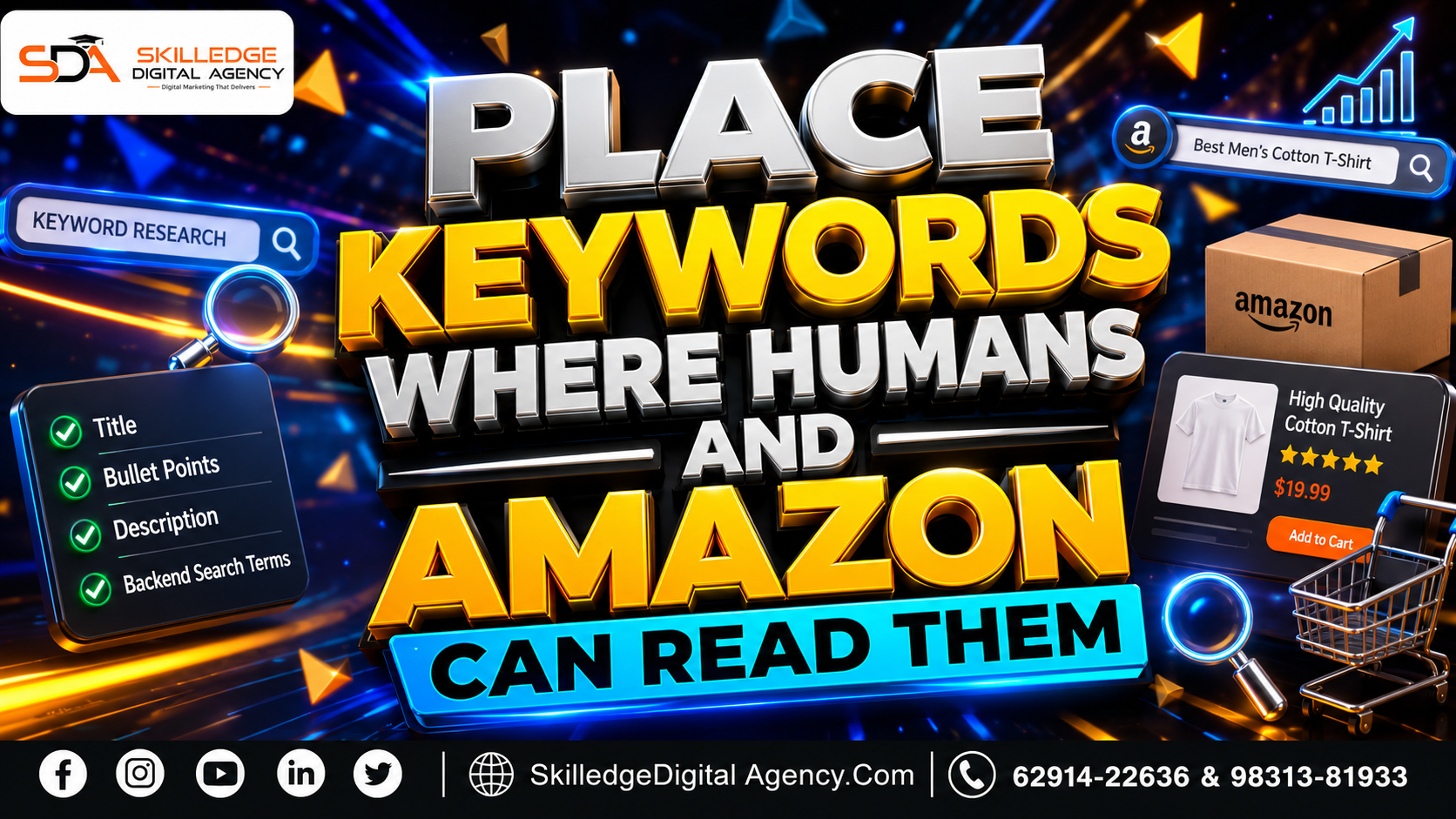
Step 2: Place Keywords Where Humans AND Amazon Can Read Them: Amazon SEO: how to rank your product on the first page
Here’s where amazon keywords best practices diverge from old-school thinking. In the early days of Amazon SEO, you could stuff everything into back-end fields and hope that was enough. These days, placement matters for both indexing and persuasion.
A practical keyword placement blueprint:
Title: Main cluster (visibility + strongest conversion phrase)
Bullets: Secondary conversion phrases and synonyms woven into benefit-driven sentences
Description / A+ Content: Supporting LSI terms, context, and storytelling
Back-end search terms: Misspellings, alternate names, additional long-tail phrases that don’t fit naturally in customer-facing copy
When we rebuild listings at Skilledge Digital Agency, we’re ruthless about this: every keyword must justify its presence. Either it helps the algorithm match, or it helps the shopper understand and buy. If it does neither, it goes.
Listing Architecture: Turning Your Detail Page Into a High-Converting Landing Page
Titles: You’re Writing For Thumbs, Not Just Algorithms
Imagine a shopper scrolling on a mobile screen, flicking through results at high speed. You have one glance to answer three questions:
What is this?
Is it for someone like me?
Is it better than the other options I see right now?
The title is your first chance to win that glance. Yes, it must contain your primary keyword cluster for Amazon SEO, but if it reads like a random jumble of features, you’ll lose the click even if you show up near the top.
Practical title rules I use with students:
Front-load the core product type and outcome (e.g., “Noise Cancelling Wireless Headphones for Office Calls”).
Follow with 1–2 high-value differentiators (battery life, comfort, certification).
Keep it readable; if you can’t say it out loud in one breath, you’ve overdone it.
A title that blends amazon product seo with human clarity improves click-through rate (CTR), and CTR is one of the fastest ways to influence your position.
Bullets: Build A Story, Not A Catalog: Amazon SEO: how to rank your product on the first page
Bullets are where you either win or lose conversion. Random feature lists don’t work because shoppers don’t think in feature checklists—they think in problems and solutions.
When we do amazon product listing optimization at Skilledge Digital Agency, we often use a 5-bullet storyline:
Bullet 1: Who and What
Who is this for? What main problem does it solve?Bullet 2: How It Works
Core functional benefits backed by simple, believable specifics.Bullet 3: Risk Reduction
Durability, warranty, returns, certifications—anything that calms buyer anxiety.Bullet 4: Use Cases
Show how the product fits into different real-life scenarios (home, travel, office, gym, etc.).Bullet 5: Brand Promise
Brief brand positioning or mission hook that makes you feel more trustworthy than a random factory listing.
You can then weave in amazon seo optimisation phrases and LSI synonyms naturally: instead of repeating the exact keyword, you describe related concepts (e.g., “optimized for Amazon’s product search algorithm,” “built to perform in organic search rankings,” “engineered for high conversion on marketplace listings”).
This is where your copy becomes a bridge between the algorithm’s need for structured data and the human’s need for clear reasons to buy.
Images: The Silent Conversion Engine: Amazon SEO: how to rank your product on the first page
If I could get every seller to internalize one thing, it would be this: your image stack is often more important than your text. In many categories, shoppers barely read—they visually scan and make decisions based on a mix of perceived quality, clarity, and trust.
A powerful image stack usually includes:
Image 1 (Main): Clean, compliant, category-consistent, no clutter.
Image 2 (Lifestyle): Shows the product in real use, with scale and emotional context.
Image 3 (Feature Callouts): Overlay text that explains the core features visually.
Image 4 (Comparison): Before/after, old vs new, or your product vs generic alternatives (without directly naming competitors).
Image 5 (Use Case Collage): Multiple situations where the product makes life easier.
Image 6 (Technical Details): Specs, ingredients, dimensions, charts.
Image 7 (Social Proof): Reviews, awards, certifications, brand story bits.
When these images are planned as a narrative sequence, not random uploads, your conversion rate increases. Better conversion feeds into amazon product ranking factors, which in turn boosts organic visibility. Image work is not “design fluff”; it’s central to Amazon SEO.
Pricing, Inventory And Buy Box: The Underestimated Ranking Trifecta
Price As A Strategic Dial, Not Just A Margin Decision: Amazon SEO: how to rank your product on the first page
Let’s be blunt: Amazon heavily favors listings that balance good customer value with healthy marketplace revenue. You can’t ignore price if you’re serious about ranking.
What I guide clients through is a simple framework:
Understand your segment’s price band: Look at the first two pages for your main keywords; map price ranges and positions.
Decide your strategy: Are you aiming to be the “smart value” choice, the premium choice, or the aggressive promotional choice for a while?
Test within a controlled band: Small moves (e.g., 5–10% adjustments) can significantly impact conversion and amazon product ranking factors without destroying your margins.
The goal isn’t to be the cheapest. It’s to be the most compelling option at your chosen value level, so Amazon sees you as a reliable revenue generator.

Inventory Reliability: Momentum Is Hard To Gain, Easy To Lose: Amazon SEO: how to rank your product on the first page
Ranking momentum is fragile. When you run out of stock, Amazon doesn’t pause time—it lets other products prove they can perform better in your absence. When you come back, you’re essentially starting again from a weaker point.
Anything that affects:
Fill rate
Stock-outs
Unexpected listing suspensions
will affect your position indirectly by damaging your sales velocity and reliability.
At Skilledge Digital Agency, we don’t treat inventory management as a back-office concern. We treat it as part of Amazon SEO optimisation. We build simple demand forecasts based on historical data, seasonal trends, and upcoming promos, so your best-performing SKUs don’t go dark just when they’re gaining momentum.
Buy Box: The Gatekeeper Of Many Ranking Factors: Amazon SEO: how to rank your product on the first page
For many product types, Buy Box ownership determines whether your ranking work even matters. If you’re in a competitive listing (multiple sellers), Amazon decides which seller’s offer gets the primary placement—and that decision is influenced by price, fulfillment method, seller performance metrics, and more.
If your strategy involves reselling or competing on shared listings, then amazon SEO becomes partly a Buy Box game:
Tighten fulfillment performance.
Keep pricing and shipping competitive.
Maintain excellent customer service metrics.
This is less relevant for private label sellers, but for resellers, it’s a major part of amazon product ranking factors that typical blogs gloss over.
Ads And External Traffic: Using Paid Levers To Feed Organic Ranking
Why Advertising Is Part Of Amazon SEO Now
In reality, advertising has become an essential part of Amazon product seo. It’s no longer “optional.” If you want to reach the first page and stay there, you often need:
Sponsored ads to create initial visibility.
Data from those campaigns to identify high-converting keywords.
Ongoing ad support to maintain sales velocity.
One of the most powerful things advertising does is help you find conversion keywords—phrases where your product consistently converts. Once you identify them, you can:
Make them more prominent in titles and bullets.
Adjust images and copy to match the intent they represent.
Use them aggressively in your Amazon SEO strategy, while relegating lower-performing terms to supporting roles.
At Skilledge Digital Agency, we often describe this as “letting ads teach your organic strategy.” If a keyword works in ads, it’s a strong candidate to shape how you frame your listing organically.
External Traffic As A Quality Signal, Not Just A Volume Game: Amazon SEO: how to rank your product on the first page
Bringing external traffic (from Google, social media, influencers, email, etc.) to Amazon can be powerful—but only if that traffic is pre-qualified.
Random clicks that don’t buy can harm your conversion metrics, which are key amazon seo organic search ranking factors. On the other hand, well-educated, warmed-up visitors from your brand ecosystem can:
Arrive with higher intent.
Buy at higher rates.
Strengthen your overall performance signals.
If we were working together via Skilledge Digital Agency, I’d encourage you to think of external traffic like a “conversion amplifier” rather than a “traffic booster.” Before launching any external campaign, we’d make sure:
The landing listing is fully ready (images, bullets, price, reviews).
The external message matches what the Amazon page promises.
We have tracking and dashboards set up to see if external visitors are actually helping Amazon SEO or just inflating impressions.

Reviews, Ratings, And Customer Experience: The Trust Layer Behind Ranking
Reviews Aren’t Just Vanity Metrics: Amazon SEO: how to rank your product on the first page
Everyone knows reviews matter. Fewer sellers treat them as part of their product development and listing optimization loop.
Reviews influence ranking in at least two ways:
They change buyer behavior (and therefore conversion).
They signal product quality to Amazon’s systems.
What I encourage is a deliberate review strategy:
Design a great post-purchase experience that naturally leads to feedback.
Use packaging inserts or follow-up messaging (within Amazon’s rules) to educate buyers on correct use, minimizing misunderstandings that cause negative reviews.
Regularly mine reviews for patterns: Are people confused? Are they returning for specific reasons? Does your product overpromise?
You then feed this into amazon product listing optimization:
Clarify bullets and images where confusion arises.
Adjust product features if certain complaints repeat.
Highlight positive patterns (e.g., “most buyers mention comfort and durability”) in your copy and creative.
Amazon sees you resolving customer friction. Shoppers feel heard. Both forces work in your favor.
Ratings And Operational Metrics As Hidden SEO Signals: Amazon SEO: how to rank your product on the first page
Operational metrics like order defect rate, late shipment rate, and return rate don’t show up in standard “Amazon SEO tips” lists. But they influence whether Amazon trusts you.
If Amazon sees your offers causing problems, it becomes cautious about showing your products too prominently, because that could lead to customer dissatisfaction. That is why we always keep seller health metrics inside our Amazon SEO dashboards at Skilledge Digital Agency. We want to know:
Are we seeing spikes in returns for specific ASINs?
Did a change in fulfillment approach impact ratings or feedback?
Do we need to re-educate buyers via images and bullets to reduce misuse?
Ignoring this layer is like optimizing a car engine while never checking oil or tire pressure—you’ll still lose performance, but you won’t know why.
Putting It All Together: Your Practical Amazon SEO Playbook: Amazon SEO: how to rank your product on the first page
Let’s convert all of this into something you can actually use—whether you work with Skilledge Digital Agency or implement it yourself.
Step-by-Step Amazon SEO Implementation Checklist: Amazon SEO: how to rank your product on the first page
Intent Mapping & Keyword Clustering
Compile visibility and conversion keywords for each product.
Group them into clusters around specific buyer intents (e.g., “office productivity,” “home fitness,” “kid-friendly,” “eco-friendly”).
Use synonyms and related phrases to create robust semantic coverage.
Listing Blueprint
Title: Combine product type, main outcome, and 1–2 differentiators.
Bullets: Build a story arc that answers the buyer’s sequence of questions.
Description/A+: Add depth and LSI phrases, plus brand story.
Backend search terms: Fill in gaps with alternate phrases and misspellings.
Image Strategy
Plan a 7+ image sequence that covers core use, features, comparisons, and trust.
Align each image with specific parts of the bullet story to reinforce benefits visually.
Price & Inventory Alignment
Decide your positioning: smart value, premium, or promotional.
Test small price bands instead of radical changes.
Forecast inventory to avoid stock-outs across key SKUs.
Ad-Driven Learning
Launch targeted ad campaigns focused on likely conversion keywords.
Analyze which keywords produce strong CTR and conversion, then reframe your organic listing around those winners.
Use ads strategically during launches, seasonality, and category shifts.
External Traffic & Brand Integration
Run focused external campaigns that align closely with your Amazon listing’s promise.
Track whether external traffic is improving conversion or just inflating sessions.
Integrate Amazon listings into your broader brand content and funnels.
Review & CX Feedback Loop
Monitor reviews weekly for new patterns.
Adjust listing content and product features based on recurring themes.
Ensure support and fulfillment operate cleanly to maintain high ratings and low defect rates.
Regular Performance Reviews
Every month, review search term reports, ranking positions, CTR, conversion, and profit.
Pick 1–2 test variables per product (e.g., image 2, bullet 1, price) and iterate.
Document what works and apply winning patterns to other listings.
When you run this playbook consistently, your Amazon SEO becomes less “mysterious” and more like a data-driven marketing system. You start seeing movement not because of hacks but because you’re aligning with how Amazon wants products to perform.

How Skilledge Digital Agency Fits Into Your Journey: Amazon SEO: how to rank your product on the first page
You might be thinking, “This all makes sense, but I don’t have the bandwidth to do it properly for my entire catalog.” That’s exactly where Skilledge Digital Agency is built to help.
We work with you in two modes:
Mentor Mode: We coach you (and your team) on how to think, test, and iterate like marketplace strategists. You keep control, but you gain a new level of insight and process.
Execution Mode: We take the heavy lifting—creating the Amazon SEO strategy, rebuilding listings, designing image stacks, running ads, testing prices—while you focus on product and brand.
In both modes, our philosophy stays the same: we don’t chase gimmicks. We build systems. That way, you’re not just ranking one hero product—you’re building a brand that knows how to consistently appear where buyers are looking and convert them at profitable levels.
Skilledge Digital Agency

What Skilledge Digital Agency delivers for your brand
| Service / Feature | What you get | Included in |
|---|---|---|
Search Engine Optimization (SEO) | ||
Technical SEO Audit Site speed, crawlability, Core Web Vitals, schema markup | Faster rankings, zero penaltiesFull technical overhaul with monthly monitoring | All Plans |
Keyword Strategy & Mapping Competitor gap analysis + intent-based clustering | Traffic that convertsTarget buyers, not browsers | All Plans |
Authority Link Building White-hat backlinks from DA 40+ real publishers | Domain authority growthSustainable, Google-safe link profile | Growth+ |
Local & Hyperlocal SEO GMB optimization, citations, local schema | Dominate “near me” searchesMap pack visibility + local trust signals | All Plans |
Paid Advertising (PPC & Meta) | ||
Google Ads Management Search, Display, Shopping & Performance Max | 3–5× ROAS targetExpert bid strategy + A/B ad copy testing | Growth+ |
Meta / Instagram Ads Audience targeting, retargeting funnels, creative testing | Lower CPL, higher CTRFull-funnel Meta campaigns built to scale | Growth+ |
Landing Page Optimization CRO-focused pages designed to convert ad traffic | Higher Quality ScoreReduced bounce, better ad relevance | Elite |
Content Marketing | ||
SEO Blog & Article Writing Long-form, E-E-A-T optimized, topic cluster strategy | Organic traffic engineContent that ranks and drives leads for months | All Plans |
Short-form Video & Reels Script, shoot guidance, editing & platform optimization | Viral-ready contentBuilt for TikTok, Instagram & YouTube Shorts | Growth+ |
Content Calendar & Strategy 30/60/90-day editorial plan aligned to business goals | Consistent brand voiceNever run out of ideas or miss a moment | All Plans |
Social Media Management | ||
Platform Management (5 channels) IG, FB, LinkedIn, X, YouTube — posting & community | Active, engaged audienceDaily management + comment/DM response | Growth+ |
Social Media Analytics Reach, engagement rate, follower growth tracking | Data-backed decisionsMonthly performance deck with insights | All Plans |
Influencer Collaboration Micro to macro influencer identification & outreach | Social proof at scaleAuthentic reach to new, targeted audiences | Elite |
Email & CRM Marketing | ||
Email Campaign Management Design, copy, list segmentation & automation flows | 40%+ open ratesPersonalized sequences that nurture and close | Growth+ |
Marketing Automation Lead nurture, cart abandonment, re-engagement drips | Revenue on autopilotWorks 24/7 to move leads down the funnel | Elite |
Analytics, Reporting & Strategy | ||
Monthly Performance Reports Custom dashboards: traffic, leads, ROAS, rankings | Full transparency, no fluffKnow exactly what’s working and why | All Plans |
GA4 + Search Console Setup Full tracking configuration, event goals, attribution | Zero tracking blind spotsAccurate data from day one | All Plans |
Competitor Intelligence Quarterly deep-dive: gaps, opportunities, market share | Stay 3 steps aheadKnow what rivals do before they scale it | Elite |
Website & Conversion | ||
CRO — Conversion Rate Optimization Heatmaps, A/B tests, UX fixes, form optimization | More leads, same trafficTurn visitors into enquiries without extra ad spend | Elite |
Website Speed & Core Web Vitals Performance optimization, image compression, caching | Google loves fast sitesBetter UX, better bounce rate, better rankings | All Plans |
Ready to grow with Skilledge?Get a free audit & custom strategy — no obligation, no fluff. | ||
Skilledge Digital Agency
If you’re ready to turn Amazon from a frustrating black box into a predictable growth channel, you can reach us here:
Phone/Whatsapp: +91 62914-22636 / 98313-81933
And for ongoing learning and support, you can connect with our ecosystem: