

If you’re trying to grow admissions in 2026, the old “brochure plus banner” approach won’t carry you far. Parents and students now compare schools and coaching centers the same way they compare phones, courses, or services: they search, shortlist, read reviews, watch videos, and judge trust before they ever call. That’s why digital marketing for schools and coaching centers has to do more than create visibility; it has to create confidence, response, and conversion.
At Skilledge Digital Agency, I’d treat this like a full admissions engine, not a posting exercise. We’re not just trying to “be online”; we’re trying to move families from curiosity to inquiry to visit to enrollment with less friction and more credibility. In education, the winning message isn’t “we’re everywhere,” it’s “we’re the safest and smartest choice for your child”.
The admissions funnel: Digital marketing for schools and coaching centers explained
Most institutions lose leads because they think marketing ends when the inquiry form is submitted. In reality, that’s where the real work starts. The strongest online marketing for schools follows a simple funnel: awareness, trust, inquiry, counseling, visit, and admission, with each stage needing different content and different proof points.
Here’s the fresh perspective: schools and coaching centers should stop asking “Which platform is best?” and start asking “Which stage of the decision journey are we influencing?” A parent on Instagram needs reassurance; a parent on Google needs answers; a student on YouTube needs proof; and a warm lead on WhatsApp needs follow-up. That’s why digital marketing for schools works best when channel strategy is matched to intent, not vanity metrics.
What parents really buy: Digital marketing for schools and coaching centers explained
Parents don’t buy ads. They buy safety, outcomes, discipline, convenience, and future opportunity. Students don’t buy course names; they buy confidence, social proof, and a path to results. When you frame digital marketing for educational institutions around these motivations, your content becomes persuasive instead of promotional.
For schools, the emotional triggers are usually environment, values, transport, academics, co-curriculars, and teacher quality. For coaching centers, the trigger is usually exam outcome, faculty credibility, doubt-solving speed, batch timing, and affordability. That’s why school digital marketing strategies and coaching tactics can share a framework, but not a message.
Positioning that wins trust: Digital marketing for schools and coaching centers explained
Before you spend on ads, fix the story. The best-performing institutions usually have a very clear positioning line: “best for early years,” “strong in board results,” “CBSE with sports excellence,” “JEE/NEET support with mentoring,” or “English medium with digital learning.” If your positioning is fuzzy, your campaigns will attract random leads instead of the right families.
At Skilledge Digital Agency, I’d recommend building a “proof stack” before campaign launch: testimonials, reviews, teacher credentials, student outcomes, campus visuals, FAQ answers, and a clear admissions process. This matters because education buyers need certainty more than creativity. Strong education marketing tips start with clarity, not cleverness.
What to say instead
Use statements that sound specific and believable:
“Small batch sizes for one-to-one doubt solving.”
“Transport access from key neighborhoods.”
“Parent updates through WhatsApp and email.”
“Structured improvement tracking every month.”
These details make lead generation for educational institutions much easier because they reduce hesitation. In education, vague claims get ignored, but measurable promises get remembered.

School SEO that brings inquiries: Digital marketing for schools and coaching centers explained
Search is where intent becomes visible. When a parent searches for a school near them, they’re not browsing casually; they’re comparing options with a purpose. That’s why SEO for schools and coaching centers should focus on local intent, service pages, FAQs, reviews, and location-specific content rather than generic blog stuffing.
A school website should include pages for admissions, curriculum, facilities, transport, fees, events, results, and contact routes. Coaching institutes should create pages for each course, batch type, faculty profile, fee structure, and exam outcome. This is how digital marketing for educational institutions becomes searchable, not just social.
Local search assets: Digital marketing for schools and coaching centers explained
The local stack matters more than most institutions realize:
Google Business Profile optimization.
Location landing pages for each branch or feeder zone.
Parent review collection after key milestones.
Map visibility for “near me” searches.
Schema markup for admissions and FAQs.
These are not optional extras; they’re core school digital marketing strategies because they help you show up when intent is high.
Content that ranks and converts
The highest-value content is often the most practical:
Admission process explainer pages.
“How to choose the right school/coaching center” guides.
Fee and scholarship answer pages.
Exam preparation roadmaps.
Parent orientation videos.
This kind of content supports online marketing for schools because it answers the exact questions people ask before contacting you. It also improves trust because it reduces the sense that you’re hiding information.
Social proof on social media: Digital marketing for schools and coaching centers explained
Social media works in education when it feels like a living campus diary, not a poster wall. Parents want to see discipline, activity, learning culture, and communication quality. Students want to see energy, achievement, peers, and possibility. That’s why social media marketing for schools should be built around authenticity, consistency, and visible proof.
Use Instagram for stories, reels, and campus highlights. Use Facebook for parent-facing updates, events, and community trust. Use YouTube for tours, testimonials, class snippets, and faculty explainers. If you’re running a coaching brand, short-form success stories and doubt-clearing clips can be especially powerful.

Content buckets that work: Digital marketing for schools and coaching centers explained
A practical weekly content system:
Student achievements.
Teacher highlights.
Event recap reels.
Parent testimonials.
Classroom snapshots.
Result announcements.
Admission reminders.
This is one of the most reliable coaching center marketing ideas because it creates familiarity before a lead ever speaks to your counselor. Familiarity shortens the decision cycle.
A better content rule: Digital marketing for schools and coaching centers explained
Don’t ask, “What should we post?” Ask, “What proof do parents and students need today?” That question changes everything. It turns content from decoration into conversion support, which is exactly what digital marketing for schools should do.
Paid media that fills seats
Google Ads is most effective when people already have intent. Parents searching for school admission, coaching classes, or exam prep are usually much closer to inquiry than a social browser. That’s why Google Ads for coaching institutes and school campaigns should focus on high-intent keywords, geo-targeting, call extensions, and landing pages built for conversion.
Meta Ads, by contrast, are better for awareness, remarketing, open day registrations, and parent nurturing. Search and social should work together, not compete. When we build student enrollment marketing strategies, we usually map one channel for discovery, one for persuasion, and one for follow-up.
Smart campaign structure: Digital marketing for schools and coaching centers explained
A clean structure looks like this:
Search ads for high-intent admissions keywords.
Remarketing ads for site visitors and lead form abandoners.
Video ads for campus proof and testimonials.
Lead form ads for open house or counseling.
WhatsApp click-to-chat for warm prospects.
This mix is especially strong for lead generation for educational institutions because it reduces drop-offs between curiosity and contact.

Budget logic
Instead of splitting budget evenly, align spend to admission season:
Awareness months: content and video.
Pre-admission months: lead forms and remarketing.
Peak season: search ads and conversion campaigns.
Final weeks: urgency-based follow-up.
This approach is one of the simplest education marketing tips because it matches spend to buyer intent, not to habit.
Lead nurturing that closes
A lot of institutions celebrate leads, but admissions come from nurture. Parents often need multiple touchpoints before they feel ready. That means every inquiry should enter a structured follow-up system with email, WhatsApp, phone calls, and counselor support. That’s why lead generation for educational institutions must include nurture design, not just ad spend.
At Skilledge Digital Agency, I’d build a simple three-layer follow-up flow: immediate acknowledgment, useful information within 24 hours, and a reminder sequence tied to deadlines or visit dates. For coaching centers, the follow-up should include course-fit guidance, demo class invites, and result proof. For schools, it should include campus-tour scheduling, fee clarity, and parent testimonial assets.
What follow-up should contain
Each message should answer one key concern:
Is this institution credible?
Is this the right fit?
What happens next?
How quickly should I act?
That structure improves digital marketing for educational institutions because it respects the decision process instead of pushing too hard too soon.
Coaching growth that feels human: Digital marketing for schools and coaching centers explained
Coaching centers are often marketed like factories, but families respond to mentorship. Your brand should feel like a guide, not a machine. The strongest coaching center marketing ideas usually combine results, faculty visibility, doubt-solving, batch structure, and student support into one clear promise.
Students don’t just want “classes”; they want momentum. They want to know they’ll understand the subject, stick to the plan, and get feedback before they fall behind. That’s why education marketing tips for coaching centers should focus on transformation stories rather than just subject lists.
Fresh content angles for coaching
Try these:
“A week in our classroom” reels.
Student progress snapshots.
Topper interviews with process details.
Faculty explainers on tough concepts.
Parent appreciation stories.
Schedule and attendance systems.
These are better than generic discount posts because they build confidence and authority. They also support SEO for schools and coaching centers through searchable content themes.
Reputation and reviews
In education, reputation is a conversion asset. A strong review profile can lower resistance before a counselor even calls. Schools should actively collect parent reviews after events, results, open houses, and support moments. Coaching centers should gather student reviews after mock tests, doubt sessions, or exam results.
This is one area where online marketing for schools is often underused. Many institutions wait for organic praise instead of building a review system. That’s a mistake because review velocity and response quality directly shape trust.
Review system basics
A practical process:
Ask at the right moment.
Make the request easy.
Reply to every review.
Highlight stories on your site.
Turn reviews into ad creatives.
That simple loop supports digital marketing for schools more than most institutions expect because it creates third-party proof at scale.

Seasonal planning: Digital marketing for schools and coaching centers explained
Education demand is seasonal, and smart marketers plan around it. Schools often need brand-building long before admission season, while coaching centers may see spikes before exam cycles. If you treat the calendar like a strategy map, your campaigns become more efficient and predictable.
A good annual rhythm might look like this:
Off-season: content, SEO, reviews, and authority.
Pre-season: awareness campaigns and open house promotion.
Peak season: search ads, retargeting, and counseling pushes.
Closing period: urgency, WhatsApp follow-up, and remarketing.
This structure is one of the most practical school digital marketing strategies because it saves budget from being wasted during the wrong month.
What changes by season
In the early months, build trust and discoverability. In the middle months, amplify proof and event participation. Near deadlines, shift the focus to response speed and personal follow-up. That’s how student enrollment marketing strategies stay efficient instead of reactive.
Skilledge implementation model: Digital marketing for schools and coaching centers explained
If I were leading this for Skilledge Digital Agency, I’d package the offer around outcomes, not services. The client doesn’t want “SEO + Ads + Social”; they want more qualified inquiries, better parent trust, and stronger admissions. That’s why digital marketing for schools should be sold as a growth system with reporting, content, lead handling, and conversion support.
Here’s the model I’d use:
Audit your current visibility, content, and lead flow.
Fix the website and inquiry paths.
Build local search assets.
Launch proof-based social content.
Run search and remarketing campaigns.
Install nurture automation.
Measure admissions, not just clicks.
That sequence keeps the strategy grounded and measurable. It also makes Skilledge Digital Agency feel like a strategic partner rather than a vendor.
What success looks like: Digital marketing for schools and coaching centers explained
Success in education marketing isn’t just traffic growth. It’s more qualified calls, more campus visits, better counselor conversations, and higher admission closes. When we track the full journey, lead generation for educational institutions becomes far more predictable.
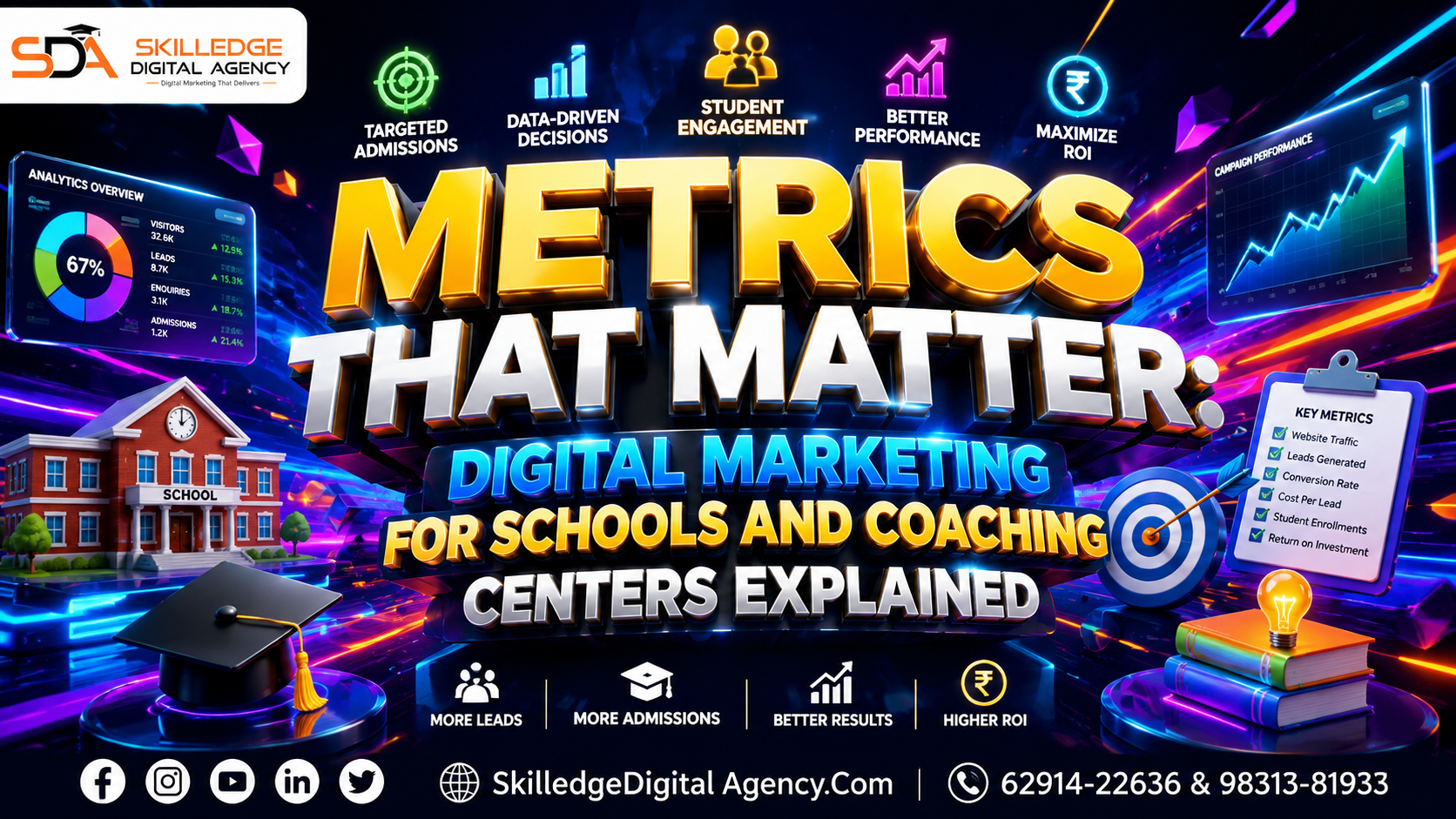
Metrics that matter: Digital marketing for schools and coaching centers explained
Too many reports stop at impressions and likes. Those numbers can be useful, but they don’t pay admission fees. For schools and coaching centers, the important metrics are inquiry quality, lead-to-visit rate, visit-to-admission rate, cost per qualified lead, and counselor follow-up speed.
Use a dashboard that shows:
Website visits by intent page.
Calls, chats, and form submissions.
Open house or demo-class registrations.
Review growth and response rates.
Conversion by channel and audience.
That’s the data framework I’d use inside digital marketing for educational institutions because it keeps everyone focused on business outcomes, not platform vanity.
Common mistake to avoid: Digital marketing for schools and coaching centers explained
Don’t judge a campaign too early. Education decisions take time, and many good leads convert after multiple touchpoints. If you stop tracking after the first click, you’ll underestimate what digital marketing for schools is actually doing.
Final build system
The strongest education brands do three things well: they show proof, answer questions, and stay visible at the right moment. If you do those three consistently, your marketing stops feeling like a cost and starts behaving like an admissions engine. That’s the core lesson behind digital marketing for schools and coaching growth.
At Skilledge Digital Agency, we’d position your institution to win with trust-first messaging, search visibility, parent-friendly content, and responsive lead handling. That blend is what makes school digital marketing strategies effective in the real world, not just on paper. When you align your website, ads, social proof, and follow-up process, your brand becomes easier to choose.
Skilledge Digital Agency

What Skilledge Digital Agency delivers for your brand
| Service / Feature | What you get | Included in |
|---|---|---|
Search Engine Optimization (SEO) | ||
Technical SEO Audit Site speed, crawlability, Core Web Vitals, schema markup | Faster rankings, zero penaltiesFull technical overhaul with monthly monitoring | All Plans |
Keyword Strategy & Mapping Competitor gap analysis + intent-based clustering | Traffic that convertsTarget buyers, not browsers | All Plans |
Authority Link Building White-hat backlinks from DA 40+ real publishers | Domain authority growthSustainable, Google-safe link profile | Growth+ |
Local & Hyperlocal SEO GMB optimization, citations, local schema | Dominate “near me” searchesMap pack visibility + local trust signals | All Plans |
Paid Advertising (PPC & Meta) | ||
Google Ads Management Search, Display, Shopping & Performance Max | 3–5× ROAS targetExpert bid strategy + A/B ad copy testing | Growth+ |
Meta / Instagram Ads Audience targeting, retargeting funnels, creative testing | Lower CPL, higher CTRFull-funnel Meta campaigns built to scale | Growth+ |
Landing Page Optimization CRO-focused pages designed to convert ad traffic | Higher Quality ScoreReduced bounce, better ad relevance | Elite |
Content Marketing | ||
SEO Blog & Article Writing Long-form, E-E-A-T optimized, topic cluster strategy | Organic traffic engineContent that ranks and drives leads for months | All Plans |
Short-form Video & Reels Script, shoot guidance, editing & platform optimization | Viral-ready contentBuilt for TikTok, Instagram & YouTube Shorts | Growth+ |
Content Calendar & Strategy 30/60/90-day editorial plan aligned to business goals | Consistent brand voiceNever run out of ideas or miss a moment | All Plans |
Social Media Management | ||
Platform Management (5 channels) IG, FB, LinkedIn, X, YouTube — posting & community | Active, engaged audienceDaily management + comment/DM response | Growth+ |
Social Media Analytics Reach, engagement rate, follower growth tracking | Data-backed decisionsMonthly performance deck with insights | All Plans |
Influencer Collaboration Micro to macro influencer identification & outreach | Social proof at scaleAuthentic reach to new, targeted audiences | Elite |
Email & CRM Marketing | ||
Email Campaign Management Design, copy, list segmentation & automation flows | 40%+ open ratesPersonalized sequences that nurture and close | Growth+ |
Marketing Automation Lead nurture, cart abandonment, re-engagement drips | Revenue on autopilotWorks 24/7 to move leads down the funnel | Elite |
Analytics, Reporting & Strategy | ||
Monthly Performance Reports Custom dashboards: traffic, leads, ROAS, rankings | Full transparency, no fluffKnow exactly what’s working and why | All Plans |
GA4 + Search Console Setup Full tracking configuration, event goals, attribution | Zero tracking blind spotsAccurate data from day one | All Plans |
Competitor Intelligence Quarterly deep-dive: gaps, opportunities, market share | Stay 3 steps aheadKnow what rivals do before they scale it | Elite |
Website & Conversion | ||
CRO — Conversion Rate Optimization Heatmaps, A/B tests, UX fixes, form optimization | More leads, same trafficTurn visitors into enquiries without extra ad spend | Elite |
Website Speed & Core Web Vitals Performance optimization, image compression, caching | Google loves fast sitesBetter UX, better bounce rate, better rankings | All Plans |
Ready to grow with Skilledge?Get a free audit & custom strategy — no obligation, no fluff. | ||
Skilledge Digital Agency
Phone/Whatsapp: +91 62914-22636 / 98313-81933
Email: Mktg@SkilledgeDigitalAcademy.Com
Website: www.skilledgedigitalacademy.com/services/
Get Directions
Facebook
Twitter
Instagram
LinkedIn