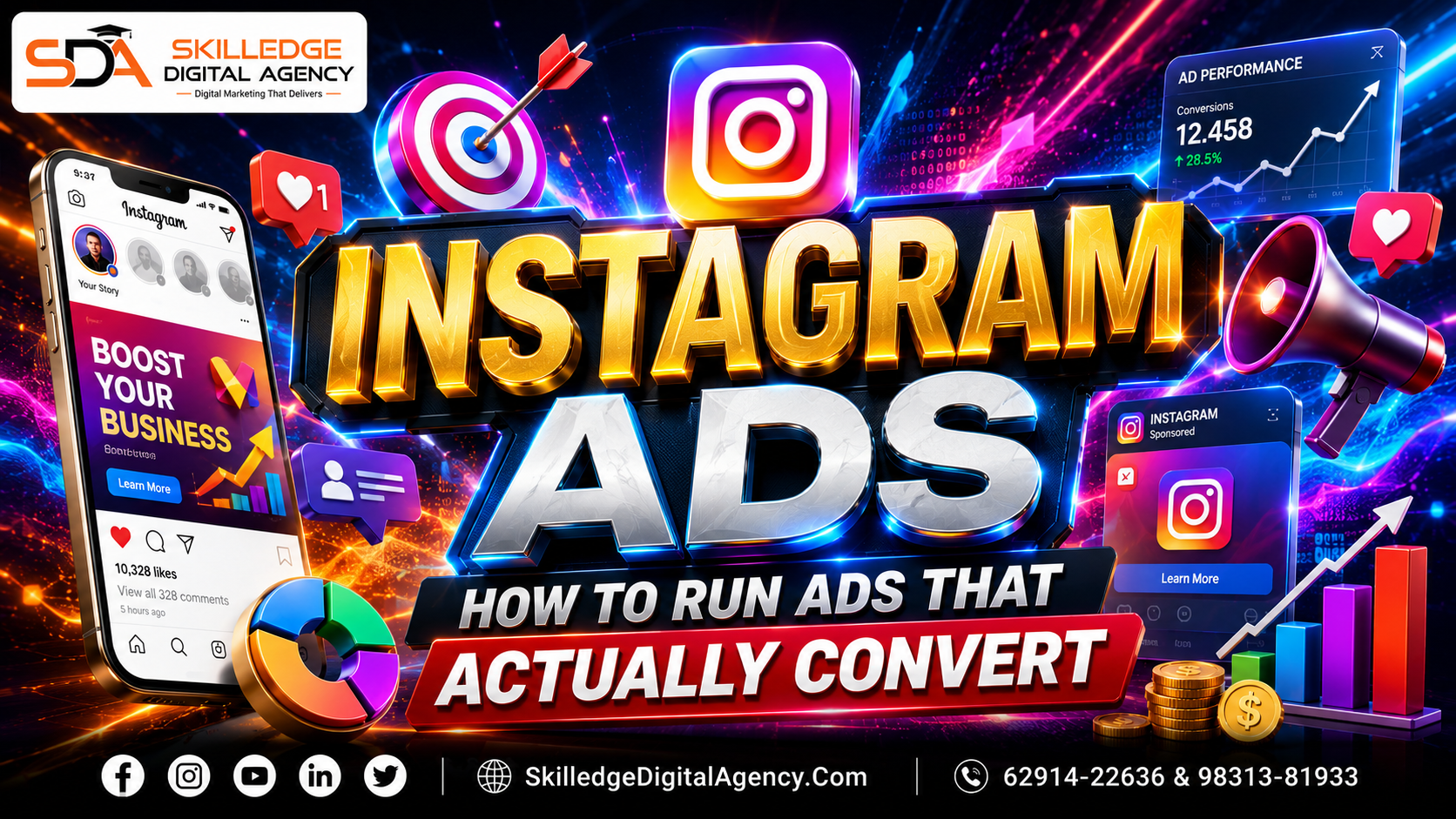
Instagram ads can drive real business growth, but only when they’re built with a conversion-first mindset. Too many brands treat Instagram advertising like a visibility game, chasing likes, views, and followers while ignoring the one outcome that really matters: profitable action: Instagram advertising: how to run ads that actually convert
That’s where we do things differently at Skilledge Digital Agency. We don’t launch campaigns just to “be present” on the platform. We build Instagram ads systems that connect strategy, creative, offer, landing page, and measurement into one clean path toward conversion.
If you’ve ever wondered why your ads get clicks but not sales, or why your cost per result keeps rising even when the creative looks good, this guide is for you. We’ll break down how to run Instagram ads that actually convert, what mistakes to avoid, how to structure your campaigns, how to read the numbers, and how to improve performance without guessing.
And we’ll do it the way a mentor should: clearly, practically, and with enough detail that you can actually apply it to your next campaign.
Why Instagram Ads Fail: Instagram advertising: how to run ads that actually convert
Most Instagram ad campaigns don’t fail because the platform is broken. They fail because the strategy is broken.
The biggest mistake brands make is starting with the ad instead of the business outcome. They ask, “What should this creative look like?” before asking, “What is the customer supposed to do, and why would they do it now?” That reversal causes weak messaging, poor targeting, and wasted spend.
A second mistake is relying on surface-level marketing logic. A beautiful ad with a generic message may earn attention, but attention alone doesn’t pay the bills. Conversion happens when the ad speaks to a real desire, removes friction, and creates enough trust for the user to take the next step.
A third problem is disconnection. The ad promise, landing page, offer, and follow-up often feel like four different campaigns run by four different people. When that happens, the user gets confused, and confusion kills conversion.
At Skilledge Digital Agency, we see the same pattern repeatedly: brands with decent design and weak strategy. The solution is rarely “more budget.” It’s usually a better system.
The Conversion Mindset: Instagram advertising: how to run ads that actually convert
Running ads that convert starts with thinking like a buyer, not a marketer.
When people scroll Instagram, they are not sitting there waiting for your offer. They’re in a fast-moving, emotionally driven, visually rich environment. Your job is to interrupt that scroll with relevance, not noise. You need to earn the click by showing the user that your message fits a need they already have or a desire they already feel.
That means every campaign should answer three questions immediately:
What problem does this solve?
Why should the user care now?
What should happen after the click?
If you can’t answer those in one clean sentence each, the campaign is too vague.
A conversion-first mindset also means you stop obsessing over vanity metrics. A post with high engagement but no revenue is not a successful campaign. A reel with thousands of likes but no lead flow is not a growth engine. What matters is the ability of the campaign to move people closer to a meaningful business outcome.
This is why Instagram ads should be treated like a system, not a post. The system includes the creative, the hook, the audience, the offer, the landing page, and the retargeting sequence. If one piece is weak, the whole machine loses efficiency.
Build an Offer That Converts
The offer is the heart of the campaign. Weak offers create weak ads, no matter how clever the creative is.
A strong offer is not just a discount. It’s a clear reason to act. It reduces hesitation, increases perceived value, and gives the audience a practical next step. If your offer feels too broad, too generic, or too self-serving, people won’t move.
The best offers usually contain one or more of the following:
A clearly defined outcome.
A specific bonus.
A strong time-sensitive element.
A low-risk entry point.
A proof-backed promise.
A solution to a painful problem.
For example, compare these two offers:
“Shop our new skincare collection.”
“Get a 7-day acne control routine with a free skin consultation.”
The second offer is stronger because it gives the user a result, a timeframe, and a reason to trust the process. It’s not just a product pitch. It’s a solution.
That matters because people don’t buy products; they buy outcomes, convenience, confidence, speed, status, or relief. Good Instagram ads translate those motivations into language the audience can understand fast.
At Skilledge Digital Agency, we often begin with offer clarity before touching media buying. Why? Because if the offer doesn’t pull, the best ad in the world will struggle.
Creative That Stops the Scroll: Instagram advertising: how to run ads that actually convert
Creative is where attention is won or lost. Instagram is a visual platform, so the creative has to do two jobs at once: interrupt the scroll and communicate a meaningful message fast.
The mistake most businesses make is overproducing ads. They think polished equals effective. In reality, the highest-converting Instagram ads often look native to the platform, not like a traditional commercial. They feel human, direct, and specific.
Some of the strongest creative formats include:
UGC-style videos.
Founder-led explainers.
Before-and-after demonstrations.
Carousel ads with step-by-step value.
Testimonial clips.
Product-in-use reels.
Problem/solution formats.
The real difference-maker is the hook. The first two seconds matter more than the rest of the clip because that’s where the user decides whether to keep watching. A weak hook can kill a strong offer. A strong hook can rescue an average creative, at least long enough to test it properly.
A few examples of strong hooks:
“We increased lead quality without increasing spend.”
“This one mistake is killing your ad conversions.”
“Here’s why your traffic is cheap but your sales are not.”
“Most brands are wasting money on Instagram ads for this reason.”
Those are specific, outcome-oriented, and curiosity-driven. They speak to a pain point rather than shouting a generic claim.
When we build campaigns at Skilledge Digital Agency, we don’t ask, “What’s pretty?” We ask, “What will the user believe in the first three seconds?” That shift alone improves creative performance.
Targeting with Precision
Targeting still matters, but the way we use it has changed.
A few years ago, advertisers could stack interests and get decent results. Today, the platform is smarter, user behavior is more fragmented, and creative often carries more weight than ultra-specific audience filters. That doesn’t mean targeting is irrelevant. It means targeting should support the message rather than carry the entire campaign.
The smartest way to think about audience selection is in layers:
Warm audiences first.
Similar audiences second.
Broad audiences with strong creative third.
Interest-based audiences when the niche truly demands it.
Warm audiences usually include people who already engaged with your brand in some way: site visitors, video viewers, page engagers, lead form openers, or cart abandoners. These users already know something about you, so the conversion friction is lower.
Similar audiences can work when you have enough high-quality source data. But the source matters. A lookalike built from people who actually purchased is usually more valuable than one built from casual traffic.
Broad audiences work better than many advertisers expect, especially when the creative is specific enough to self-select the right buyer. If your ad speaks clearly to one need, the algorithm often does a good job finding the right people.
The point is not to over-engineer the audience. It’s to create alignment between the audience, the angle, and the offer.
Instagram Ads Manager Setup: Instagram advertising: how to run ads that actually convert
A lot of campaign confusion comes from poor setup. The platform can do a lot, but it won’t rescue messy structure.
A clean setup usually starts with a clear objective. If you want sales, lead quality, or sign-ups, your objective should reflect that. Don’t choose an awareness goal if what you really want is conversions. That creates a disconnect between what the system optimizes for and what your business needs.
In Instagram ads manager, campaign structure should stay simple enough to interpret. If you have too many ad sets, too many creatives, and too many audiences all at once, you won’t know what’s actually working. Clean structure helps you see patterns faster.
A practical setup may include:
One campaign for testing.
One campaign for retargeting.
One campaign for scaling winners.
Within each, keep the variables controlled. Test one major thing at a time if possible. That could be the hook, the format, the audience, or the offer. When you isolate variables, the data tells a clearer story.
A lot of marketers rush through setup because they want speed. Speed is good, but clarity is better. A faster campaign that teaches you nothing is usually more expensive in the long run.
Budget and Instagram Ads Cost: Instagram advertising: how to run ads that actually convert
Let’s talk about something every advertiser wants to know: Instagram ads cost.
There is no fixed price that works for every brand. Costs vary based on your niche, audience, creative quality, seasonality, competition, and campaign objective. Two brands can run the same format and see very different outcomes.
Instead of asking, “What does it cost?” ask, “What is the cost relative to the value of the conversion?” That’s a smarter question.
For example:
A lead for a high-ticket service may justify a much higher acquisition cost.
A low-margin ecommerce item needs tighter efficiency.
A subscription product can tolerate different economics than a one-time purchase.
The real task is not minimizing spend at all costs. It’s maximizing return on every rupee spent. That means watching both efficiency and quality.
If your Instagram advertising cost is low but the leads are poor, the campaign is not actually cost-effective. Cheap traffic that doesn’t convert is still waste. On the other hand, a more expensive campaign that drives highly qualified buyers can be profitable.
A good budget should be large enough to gather signal, but not so large that you scale a weak campaign blindly. We usually recommend giving campaigns enough time and spend to show a real pattern before making hard decisions.
Instagram Sponsored Ads That Feel Native
Instagram sponsored ads perform best when they don’t feel like interruptive ads. They should fit the native environment without becoming invisible.
That doesn’t mean you hide the marketing. It means the ad should feel like a helpful piece of content that happens to lead to a commercial outcome. If the creative feels too salesy, people scroll past it. If it feels too vague, they may engage but not convert.
The best sponsored ads often use one of these psychological entry points:
Pain relief.
Time saving.
Status improvement.
Convenience.
Trust and proof.
Curiosity.
For example, a B2B service provider might use a short founder video explaining how they improved lead quality. An ecommerce brand might use a product demo showing exactly how the item solves a common problem. A coach or educator might use testimonial-style content that highlights transformation.
The sponsored ad should not try to do everything at once. It should make one strong case and lead the user to the next step.
This is especially important for people who want to promote Instagram account growth while also generating leads or sales. Follower growth and conversion growth are related but not identical. Don’t design your ad like a popularity contest if your real goal is revenue.
Funnel Strategy That Actually Works: Instagram advertising: how to run ads that actually convert
If your campaign has no funnel logic, it will usually underperform over time.
People move through stages:
They discover you.
They evaluate you.
They compare you.
They decide.
Instagram ads should support that journey, not pretend every user is ready to buy immediately.
A basic funnel could look like this:
Top of funnel: awareness or problem-based content.
Middle of funnel: proof, education, testimonials, comparison.
Bottom of funnel: offer, urgency, conversion push.
Top-of-funnel ads should create interest and establish relevance. Middle-of-funnel ads should remove objections. Bottom-of-funnel ads should make it easy to act.
A lot of businesses skip straight to the buy-now message and then wonder why users don’t convert. It’s like proposing marriage on the first date. Some people might say yes, but most need a few more steps.
The best funnels don’t feel forced. They feel like a natural progression. Each stage earns trust and reduces resistance.
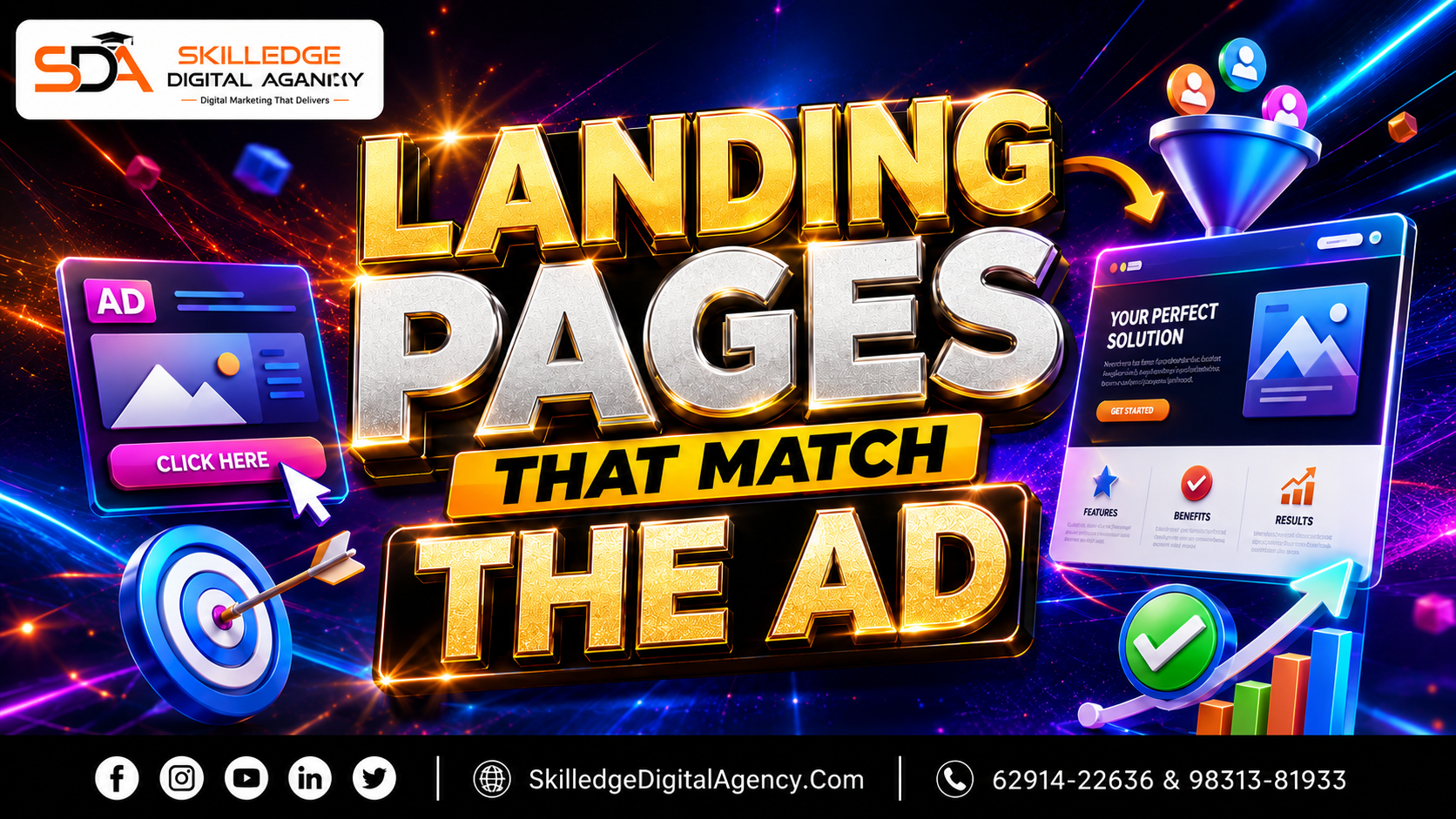
Landing Pages That Match the Ad: Instagram advertising: how to run ads that actually convert
Even strong Instagram ads fail if the landing page breaks the flow.
The landing page should continue the story the ad started. If the ad promised a free audit, the page should immediately confirm that. If the ad promised a specific result, the page should make that result visible and believable. If the ad used a certain tone, the page should feel consistent.
A high-converting landing page typically has:
A clear headline.
One primary CTA.
Fast loading speed.
Strong proof.
Concise copy.
Simple form fields.
Mobile-friendly design.
The goal is not to overload the user with information. It’s to guide them toward a decision.
One common mistake is over-explaining. People who are ready to buy don’t want a ten-minute lecture. People who are unsure need proof, not paragraphs. A landing page should answer objections quickly and clearly.
At Skilledge Digital Agency, we look at the post-click experience as part of the ad campaign, not as a separate asset. That mindset often improves conversion rates more than adjusting media alone.
Metrics That Matter: Instagram advertising: how to run ads that actually convert
You can’t improve what you don’t measure, but you also can’t measure everything equally.
The metrics that matter most depend on your objective, but generally, these are the ones worth watching:
CTR: Does the ad message resonate?
CPC: Are you paying efficiently for attention?
Conversion rate: Is the offer and landing page doing its job?
CPA: What does it cost to acquire a lead or sale?
ROAS: Are you generating revenue profitably?
Frequency: Is the audience getting fatigued?
Don’t get trapped by vanity metrics. Likes, comments, and shares can help, but they are not the final score. A campaign can go viral and still lose money. Another campaign can look quiet and quietly generate strong revenue.
The best advertisers read the story behind the numbers. If CTR is high but conversion rate is low, the ad promise may be stronger than the landing page experience. If CTR is low, the creative or hook may be weak. If frequency keeps rising while results decline, the audience may be saturated.
Numbers should lead to decisions, not confusion.
Testing Without Chaos: Instagram advertising: how to run ads that actually convert
Testing is where many campaigns go wrong because teams test too much at once.
If you change the audience, offer, creative, placement, and landing page all in one shot, you won’t know what actually caused the result. That creates false certainty and bad scaling decisions.
A disciplined testing framework usually includes:
One audience.
One offer.
One landing page.
Several creative variations.
One key variable changed at a time.
A simple test might compare three hooks across the same video concept. Another test might compare two offers with the same creative style. Another might compare a UGC format against a polished demo.
The objective is not to find the perfect ad in one round. It’s to create a learning loop. Every good test tells you something about the market.
At Skilledge Digital Agency, we think of testing like lab work. You’re not trying to impress anyone. You’re trying to isolate truth.
Retargeting That Brings Users Back: Instagram advertising: how to run ads that actually convert
Most people won’t convert on the first touch. That’s normal.
Retargeting exists to re-engage users who showed interest but didn’t act. These users are already warmer than cold traffic, so your message can be more specific and more persuasive.
Retargeting ideas:
Show testimonials to site visitors.
Show product demonstrations to people who watched part of a video.
Show limited-time offers to cart abandoners.
Show comparison creatives to users who need reassurance.
Show FAQs to visitors who bounced early.
The point is to address the objection that likely stopped them. Sometimes that objection is price. Sometimes it’s trust. Sometimes it’s timing. Sometimes it’s simply confusion.
Retargeting works best when the creative changes based on intent. A generic reminder is usually weaker than a message that directly speaks to the user’s stage in the journey.
This is another area where Instagram ads are especially useful. You can build layered remarketing sequences that move users from curiosity to commitment without forcing a hard sell too early.
Why Creative Fatigue Happens: Instagram advertising: how to run ads that actually convert
Creative fatigue is one of the biggest hidden costs in performance marketing.
Even good ads wear out. As users see the same message repeatedly, response rates usually decline. Frequency rises, engagement drops, and cost efficiency gets worse. That doesn’t always mean your product is bad. It often means the market has seen the same angle too many times.
The fix is not always a full account rebuild. Often, you just need:
New hooks.
New angles.
New visuals.
New proof points.
New CTAs.
New audience segmentation.
A lot of brands underestimate how quickly ad creative gets stale on social platforms. Instagram moves fast, and user attention moves even faster.
That’s why we recommend building creative in batches. One campaign should not depend on a single hero ad forever. Sustainable performance comes from variation.
How to Promote Instagram Account Without Losing Sales Focus: Instagram advertising: how to run ads that actually convert
Many brands want to promote Instagram account growth and drive sales at the same time. That can work, but only if the strategy is clear.
Follower growth is helpful when it supports brand trust, community building, and social proof. But follower growth alone is not a business model. If the account grows but the conversion system is weak, you’ll have a bigger audience and the same revenue problem.
The smarter approach is to treat follower growth as a side effect of value-driven content, not the main KPI. If a campaign attracts the right audience, the profile will often grow naturally anyway.
This is especially useful when your content strategy and paid strategy work together. A strong organic presence improves trust, and paid campaigns accelerate discovery. That combination can create a more efficient funnel than relying on either one alone.
Skilledge Digital Agency often helps brands balance these two goals so they don’t waste budget chasing vanity growth at the expense of actual sales.
Instagram Ads vs LinkedIn Ad Strategy: Instagram advertising: how to run ads that actually convert
It’s worth understanding how Instagram ads differ from a LinkedIn ad approach because the mindset changes the creative and offer.
Instagram is more visual, faster, and often more emotionally driven. It’s ideal for product discovery, brand building, direct response, and lifestyle-driven conversion. LinkedIn, by contrast, is more professional, context-heavy, and often better for B2B lead generation, authority positioning, and decision-maker targeting.
That means the same message won’t always work across platforms. What feels compelling on Instagram may feel too casual on LinkedIn. What feels authoritative on LinkedIn may feel stiff on Instagram.
If you’re running both, align the creative to the platform while keeping the core offer consistent. Platform-native execution usually wins.
This matters because many businesses compare performance without accounting for user intent. They treat all paid social channels the same, then get confused when the results differ.
A Simple Conversion Framework: Instagram advertising: how to run ads that actually convert
If you want a practical mental model, use this framework:
Attention + Relevance + Proof + Friction Removal + CTA
Here’s how it works:
Attention: the ad stops the scroll.
Relevance: the message speaks to a real pain or desire.
Proof: the user sees evidence that your claim is true.
Friction removal: the ad or page reduces hesitation.
CTA: the user knows exactly what to do next.
If any one of these is weak, the campaign becomes harder to scale.
This framework is simple, but simple doesn’t mean easy. It requires discipline, good creative judgment, and a willingness to test honestly. But once you use it consistently, your Instagram ads become much more predictable.
At Skilledge Digital Agency, we use frameworks like this because they keep the strategy grounded in user behavior rather than marketing hype.
Case-Like Example: Instagram advertising: how to run ads that actually convert
Imagine a brand selling an online course for small business owners.
A weak ad says:
“Learn digital marketing today.”
A better ad says:
“Struggling to get sales from social media? Here’s the exact framework we use to turn Instagram traffic into leads.”
The second version works better because it:
Names the pain point.
Shows the outcome.
Promises a practical framework.
Speaks directly to the user’s situation.
Now imagine the landing page mirrors that same promise with a clear headline, testimonial proof, course breakdown, and a strong CTA. That’s when the full system starts to work.
The same logic applies whether you sell ecommerce products, services, coaching, memberships, or training. The details change, but the structure stays the same.
The Skilledge Advantage: Instagram advertising: how to run ads that actually convert
At Skilledge Digital Agency, we look at paid social through a business lens, not just a media buying lens. We care about whether your campaign creates revenue, qualified leads, and sustainable growth.
That means we focus on:
Offer strategy.
Creative messaging.
Campaign architecture.
Retargeting logic.
Landing page alignment.
Reporting that supports decisions.
We also understand that many brands don’t need more complexity. They need sharper thinking. A campaign doesn’t have to be fancy to convert. It has to be clear, relevant, and measurable.
That’s why our process emphasizes the whole journey instead of isolated metrics. We want your Instagram ads to do more than look good in a report. We want them to contribute to business growth.
If you’re building a serious paid social engine, that difference matters.
Final Conversion Checklist: Instagram advertising: how to run ads that actually convert
Before you launch or scale, run through this checklist:
Is the offer clear and compelling?
Does the creative communicate one strong idea?
Is the hook strong enough to stop the scroll?
Is the audience aligned with the offer?
Does the landing page match the ad promise?
Are you tracking conversion metrics, not just clicks?
Is there a retargeting plan in place?
Do you have enough creative variation to avoid fatigue?
Are you making decisions from data, not assumptions?
If you can answer “yes” to most of those, you’re in much better shape than the average advertiser.
A lot of Instagram advertising success comes down to discipline. Not every campaign will win, and that’s fine. What matters is whether each campaign teaches you something useful and moves your overall system forward.
That’s how brands create reliable growth instead of random bursts of performance.
Conclusion
Instagram ads convert when they are built around the buyer’s journey, not the advertiser’s ego. The strongest campaigns combine a compelling offer, native-feeling creative, precise but not obsessive targeting, a clean landing page, and a measurement system that reveals what’s actually happening.
If you remember only one thing from this guide, remember this: attention is not conversion. Attention is just the entry point. Conversion happens when the message, the medium, and the next step all line up.
That’s the standard we follow at Skilledge Digital Agency, and it’s the same standard we recommend for any brand serious about turning paid social into real business growth.
Skilledge Digital Agency

What Skilledge Digital Agency delivers for your brand
| Service / Feature | What you get | Included in |
|---|---|---|
Search Engine Optimization (SEO) | ||
Technical SEO Audit Site speed, crawlability, Core Web Vitals, schema markup | Faster rankings, zero penaltiesFull technical overhaul with monthly monitoring | All Plans |
Keyword Strategy & Mapping Competitor gap analysis + intent-based clustering | Traffic that convertsTarget buyers, not browsers | All Plans |
Authority Link Building White-hat backlinks from DA 40+ real publishers | Domain authority growthSustainable, Google-safe link profile | Growth+ |
Local & Hyperlocal SEO GMB optimization, citations, local schema | Dominate “near me” searchesMap pack visibility + local trust signals | All Plans |
Paid Advertising (PPC & Meta) | ||
Google Ads Management Search, Display, Shopping & Performance Max | 3–5× ROAS targetExpert bid strategy + A/B ad copy testing | Growth+ |
Meta / Instagram Ads Audience targeting, retargeting funnels, creative testing | Lower CPL, higher CTRFull-funnel Meta campaigns built to scale | Growth+ |
Landing Page Optimization CRO-focused pages designed to convert ad traffic | Higher Quality ScoreReduced bounce, better ad relevance | Elite |
Content Marketing | ||
SEO Blog & Article Writing Long-form, E-E-A-T optimized, topic cluster strategy | Organic traffic engineContent that ranks and drives leads for months | All Plans |
Short-form Video & Reels Script, shoot guidance, editing & platform optimization | Viral-ready contentBuilt for TikTok, Instagram & YouTube Shorts | Growth+ |
Content Calendar & Strategy 30/60/90-day editorial plan aligned to business goals | Consistent brand voiceNever run out of ideas or miss a moment | All Plans |
Social Media Management | ||
Platform Management (5 channels) IG, FB, LinkedIn, X, YouTube — posting & community | Active, engaged audienceDaily management + comment/DM response | Growth+ |
Social Media Analytics Reach, engagement rate, follower growth tracking | Data-backed decisionsMonthly performance deck with insights | All Plans |
Influencer Collaboration Micro to macro influencer identification & outreach | Social proof at scaleAuthentic reach to new, targeted audiences | Elite |
Email & CRM Marketing | ||
Email Campaign Management Design, copy, list segmentation & automation flows | 40%+ open ratesPersonalized sequences that nurture and close | Growth+ |
Marketing Automation Lead nurture, cart abandonment, re-engagement drips | Revenue on autopilotWorks 24/7 to move leads down the funnel | Elite |
Analytics, Reporting & Strategy | ||
Monthly Performance Reports Custom dashboards: traffic, leads, ROAS, rankings | Full transparency, no fluffKnow exactly what’s working and why | All Plans |
GA4 + Search Console Setup Full tracking configuration, event goals, attribution | Zero tracking blind spotsAccurate data from day one | All Plans |
Competitor Intelligence Quarterly deep-dive: gaps, opportunities, market share | Stay 3 steps aheadKnow what rivals do before they scale it | Elite |
Website & Conversion | ||
CRO — Conversion Rate Optimization Heatmaps, A/B tests, UX fixes, form optimization | More leads, same trafficTurn visitors into enquiries without extra ad spend | Elite |
Website Speed & Core Web Vitals Performance optimization, image compression, caching | Google loves fast sitesBetter UX, better bounce rate, better rankings | All Plans |
Ready to grow with Skilledge?Get a free audit & custom strategy — no obligation, no fluff. | ||
Skilledge Digital Agency
Phone/Whatsapp: +91 62914-22636 / 98313-81933
Email: Mktg@SkilledgeDigitalAcademy.Com
Website: www.skilledgedigitalacademy.com/services/
Get Directions
Facebook
Twitter
Instagram
LinkedIn