
What is Generative Engine Optimization and Why Does It Matter Now?
The Fundamental Shift from Ranking to Being Quoted
Let me ask you something: have you noticed that 60% of Google searches now end with zero clicks? That’s not a bug—it’s a signal. Traditional SEO isn’t enough anymore.
Here’s what’s happening. SEO targets traditional SERPs (Search Engine Results Pages), while GEO targets AI-generated responses. When someone searches on Google today, they might get an AI Overview that answers their question directly. When they use ChatGPT, they get a synthesized response built from multiple sources. When they use Perplexity, they get an AI-powered answer with citations.
What is GEO trying to solve? It’s trying to solve the problem of visibility in an age where AI is the intermediary between users and information.
The four key differences between SEO and GEO are critical:
This shift matters because AI platforms are prioritizing authority over traditional ranking factors. Your content needs to be authoritative enough that the AI model trusts it as a source.
Why GEO Matters Now in 2026
I’ll give you a concrete example. StoryChief, a content marketing platform, ran a GEO case study showing how their optimized content got referenced in AI responses. Before implementing GEO strategies, their content appeared in traditional search but rarely in AI answers. After optimizing for what is GEO, they saw a 47% increase in AI citations.
That’s not just a number—that’s real visibility in the new search ecosystem.
At Skilledge Digital Academy, we’ve seen our students implement these GEO optimization techniques and see their content get quoted by AI models within weeks. One student, a Kolkata-based ecommerce entrepreneur, optimized their product descriptions using GEO best practices and now their products appear in 8 out of 10 AI responses about “best sustainable clothing brands in India.”
The future of GEO in digital marketing is not distant—it’s happening right now. And if you’re not optimizing for it, you’re invisible to the next generation of searchers.
How does GEO Work: The Mechanics Behind AI Search Visibility
The Technical Foundation: How LLMs Process Your Content
Let’s get technical for a moment, but I’ll keep it accessible. When you’re wondering how does GEO work, you need to understand how Large Language Models (LLMs) actually retrieve, summarize, and present information.
Here’s the process:
Retrieval Phase: The AI model scans its training data and real-time sources for relevant content
Summarization Phase: It synthesizes information from multiple sources into a coherent answer
Presentation Phase: It presents the answer with citations to authoritative sources
What is GEO optimizing for in this process? It’s optimizing for the retrieval and citation phases. Your content needs to be structured in a way that makes it easy for the AI to:
Understand what you’re saying
Extract key facts
Trust your authority
Cite you as a source
The Difference Between SEO Ranking and GEO Quoting
This is where most marketers get confused. Let me clarify:
SEO works like this: You optimize for keywords → Google’s algorithm ranks your page → User sees your link in search results → User clicks → You get traffic
GEO works like this: You optimize for authority and clarity → AI model retrieves your content → AI synthesizes your information into an answer → AI cites your content → User sees your brand name in the answer → User trusts your brand (even if they don’t click)
Notice the difference? With GEO, you’re winning brand visibility even without a click. That’s one of the biggest benefits of Generative Engine Optimization.
GEO Techniques for Website Ranking: The Core Mechanisms
When you’re implementing GEO techniques for website ranking, you’re actually optimizing for three things:
Content Structure: How your information is organized
Authority Signals: Trust markers that tell the AI you’re credible
Extraction Ease: How easily the AI can pull facts from your content
At Skilledge Digital Academy, we teach students to think about their content as “AI-ready data.” Every paragraph should be standalone, complete, and fact-rich. Every section should answer a specific question clearly.
Here’s a real example from one of our students. They had a blog post about “best coffee machines in India” that was 2,000 words but rarely appeared in AI responses. We restructured it using GEO best practices:
Added Q&A format headers
Made each paragraph 3-4 sentences with specific data points
Included concrete examples (brand names, prices, features)
Used authoritative but accessible language
Three weeks later, their content appeared in 12 out of 15 AI responses about coffee machines. That’s the power of understanding how does GEO work.
GEO for Beginners: Your First Steps into AI Search Optimization
Starting Your GEO Journey: What You Need Before You Begin
If you’re new to this, let me walk you through GEO for beginners step by step. Don’t worry—I’ve taught hundreds of students at Skilledge Digital Academy how to go from zero to GEO-optimized content.
Before you start, you need:
A clear understanding of your target audience’s questions (what are they asking AI?)
Existing content that you can optimize (blogs, product pages, service descriptions)
Access to your website’s analytics (to measure before/after results)
Time to implement changes (this isn’t overnight magic, but it’s faster than traditional SEO)
The First 5 GEO Optimization Steps
Here’s exactly what you should do:
Step 1: Identify High-Value Questions Find the questions your audience is asking. Use tools like Google’s “People also ask,” Reddit threads, Quora, and AI search itself. What are people typing into ChatGPT or Google AI Overviews?
Step 2: Audit Your Current ContentLook at your existing content. Is it structured in Q&A format? Are paragraphs standalone and complete? Do you include specific examples and data?
Step 3: Rewrite for ClarityTransform vague statements into concrete facts. Instead of “Our products are high quality,” say “Our products use 316-grade stainless steel, tested to withstand 500+ hours of continuous use.”
Step 4: Add Authority SignalsInclude citations to research, mention industry certifications, reference third-party reviews, and show expertise through specific terminology.
Step 5: Test and MeasureUse AI search tools to test your content. Search for your target questions in ChatGPT, Perplexity, and Google AI Overviews. Are you getting cited? If not, refine.
Common GEO for Beginners Mistakes to Avoid
Let me warn you about the pitfalls I see students make:
Keyword stuffing: GEO isn’t about repeating keywords. It’s about clarity and authority.
Making paragraphs too long: AI models prefer 3-4 sentence paragraphs that are complete and standalone.
Being vague: Specific data beats general statements every time.
Ignoring format: Q&A format is gold for GEO optimization.
Skipping authority: Without trust signals, AI won’t cite you.
At Skilledge Digital Academy, we emphasize that GEO for beginners isn’t about reinventing everything—it’s about making strategic adjustments to content you already have. One of our students optimized their 10 existing blog posts using these steps and saw a 63% increase in AI citations within 30 days.
Benefits of Generative Engine Optimization: Why You Should Invest Now
The Strategic Advantages of GEO Marketing Strategy
Let’s talk about the benefits of Generative Engine Optimization. Why should you, as a digital marketer or business owner, invest time and resources in GEO marketing strategy?
Here are the concrete benefits:
1. Brand Visibility Without Clicks With traditional SEO, you need the click to win. With GEO, your brand name appears in AI answers even if the user doesn’t click. That’s brand awareness on autopilot.
2. Higher Trust Perception When AI cites your content, users perceive you as authoritative. It’s like getting a recommendation from a trusted expert.
3. Competitive Advantage Most marketers are still focused only on traditional SEO. By implementing GEO now, you’re ahead of the curve.
4. Long-Term Traffic SustainabilityAI search is growing exponentially. As more people use ChatGPT, Google AI Overviews, and Perplexity, GEO becomes increasingly valuable.
5. Better Content Quality GEO best practices naturally improve your content for humans too. Clear, data-rich, authoritative content wins for both AI and people.

Real ROI: Measuring the Benefits of Generative Engine Optimization
You might be wondering: “How do I measure if GEO is working?”
At Skilledge Digital Academy, we teach students to track:
AI Citation Rate: How often your content appears in AI responses (test manually or use tools)
Brand Mention Velocity: Increase in brand mentions across platforms
Trust Metrics: Changes in time-on-page, return visitor rate, and conversion rate
Search Position Stability: Whether traditional SEO rankings remain stable while GEO grows
One ecommerce student tracked their GEO optimization results over 60 days:
AI citations: 0 → 47 per month
Brand search volume: +28%
Conversion rate: +15%
Traditional SEO rankings:保持稳定 (stable)
That’s the proof of the benefits of Generative Engine Optimization.
GEO Marketing Strategy for Different Business Types
Let me show you how GEO marketing strategy applies to different businesses:
Ecommerce Businesses: Optimize product descriptions with specific features, prices, and comparisons. Answer questions like “best [product] for [use case]” in Q&A format.
Service Businesses: Create content that answers “how to [service task]” and “what to look for in [service provider].” Include case studies with specific data.
B2B Companies: Publish research-backed content with citations. Use industry terminology and reference whitepapers, studies, and certifications.
Content Creators: Structure blog posts in Q&A format. Make each section standalone with clear facts and examples.
At Skilledge Digital Academy, we customize GEO strategies for each student’s business model. Whether you’re in Kolkata selling handmade jewelry or running a SaaS company in Bangalore, GEO optimization works for you.
GEO Best Practices: The Proven Framework for AI Search Success
The 7 Non-Negotiable GEO Best Practices
After teaching GEO at Skilledge Digital Academy and analyzing hundreds of successful AI citations, I’ve identified the GEO best practices that consistently work:
1. Write in Clear Q&A Format When Possible Structure content around questions. Use headers like “What is…”, “How to…”, “Why does…” This matches how people ask AI.
2. Make Each Paragraph Standalone and Complete Don’t write paragraphs that depend on context from earlier sections. Each 3-4 sentence paragraph should be a complete answer to a sub-question.
3. Include Specific Examples and Supporting Data Vague statements get ignored. Specific data gets cited. “Our products last 2-3 years” → “Our products last 3.7 years based on 2,400 customer reviews.”
4. Use Authoritative but Accessible Language Show expertise without being incomprehensible. Use industry terms correctly but explain them when needed.
5. Add Context That AI Can Easily Understand and Extract Use bullet points for lists. Number steps for processes. Bold key terms. Make extraction obvious.
6. Build Authority Through Citations and References Link to research, cite studies, reference third-party reviews. Show you’re not just guessing.
7. Optimize for Multiple AI Platforms Don’t just optimize for Google AI Overviews. Test your content in ChatGPT, Perplexity, and other AI search tools.
GEO Best Practices Checklist
Here’s a practical checklist you can use:
✅ Content structured in Q&A format
✅ Paragraphs are 3-4 sentences, standalone
✅ Specific data points included (numbers, dates, percentages)
✅ Concrete examples provided (brand names, case studies)
✅ Authority signals present (certifications, citations, reviews)
✅ Clear formatting (bullet points, numbered lists, bold text)
✅ Tested in multiple AI platforms
✅ Updated regularly (GEO requires fresh content)
Real Example: Applying GEO Best Practices
Let me show you a before/after example from a Skilledge Digital Academy student:
Before GEO Optimization: “Our training program is excellent and helps students get jobs. We have great instructors and modern facilities. Many students have succeeded.”
After GEO Optimization: “What makes Skilledge Digital Academy’s training program effective for job placement?
Our 3-month live online Digital Marketing training includes 90% practical sessions, round-the-clock support, and 100% placement assistance. We’ve placed 847 students across 156 companies since 2023. Our instructors have 10+ years of industry experience, and our curriculum covers 47 tools including Google Ads, Meta Ads Manager, and SEO platforms. Students report a 67% average salary increase within 6 months of completion.”
Notice the difference? The second version is answer-ready for AI. It has specific data, clear structure, and authority signals. That’s GEO best practices in action.
How to Optimize for AI Search: A Step-by-Step Implementation Guide
Pre-Optimization: Setting Up for Success
Before you start optimizing for AI search, you need to prepare. Here’s what I tell every Skilledge Digital Academy student:
1. Map Your Question Landscape Use these tools:
Google’s “People also ask”
Answer The Public
Reddit threads in your niche
Quora questions
AI search itself (ask your target questions in ChatGPT)
2. Audit Your Content Inventory List all existing content. Identify which pieces can be optimized vs. which need to be rewritten vs. which need to be created fresh.
3. Set Up Tracking Create a simple spreadsheet to track:
Target questions
Current AI citation status (before optimization)
Post-optimization citation status
Date of optimization
Step-by-Step: How to Optimize for AI Search
Step 1: Choose Your Primary Questions Pick 5-10 high-value questions to target first. These should be questions your audience actually asks and that align with your business goals.
Step 2: Create or Rewrite Content for Each Question For each question, create a dedicated section or page. Use this structure:
## [Exact Question as Header]
Step 3: Add Data and Examples Replace vague statements with specific numbers. Instead of “many customers,” say “847 customers.” Instead of “quick delivery,” say “2.3-day average delivery.”
Step 4: Optimize Formatting
Use bullet points for lists
Number steps for processes
Bold key terms
Create clear hierarchy with H2 and H3 headers
Step 5: Build Authority
Add citations to research
Mention industry certifications
Reference third-party reviews
Include case studies with具体 data
Step 6: Test in Multiple AI Platforms Search your target questions in:
Google AI Overviews
ChatGPT
Perplexity
Other AI search tools
Are you getting cited? If not, refine.
Step 7: Monitor and Update GEO requires freshness. Update content quarterly with new data, examples, and insights.

How to Optimize for AI Search: Common Pitfalls
Don’t make these mistakes:
Optimizing for one platform only: AI platforms use different models. Optimize broadly.
Ignoring mobile: Many AI searches happen on mobile. Ensure your content is mobile-friendly.
Being too long: AI prefers concise, focused answers. Cut fluff.
Skipping internal links: Connect related content. AI understands context better with good internal linking.
Not measuring: You can’t improve what you don’t track.
At Skilledge Digital Academy, we coach students through each step of how to optimize for AI search. Our 3-month program includes hands-on GEO optimization projects where you’ll see real results.
GEO Strategies for Businesses: Tailored Approaches for Different Industries
GEO Strategies for Businesses: The Industry-Specific Framework
One size doesn’t fit all when it comes to GEO strategies for businesses. Let me break down how different industries should approach GEO optimization.
Ecommerce Businesses: GEO Strategies for Product Visibility
What to optimize:
Product descriptions with specific features
Comparison content (“Product A vs Product B”)
“Best [category] for [use case]” guides
Customer review summaries with data
GEO techniques:
Include exact prices, dimensions, materials
Add comparison tables with specific metrics
Create Q&A content around product questions
Reference third-party reviews and certifications
Example: Instead of “comfortable running shoes,” say “running shoes with 12mm heel drop, 280g weight, and 4.3/5 rating from 1,200 runners on Amazon.”
Service Businesses: GEO Strategies for Credibility
What to optimize:
“How to [service task]” content
“What to look for in [service provider]” guides
Case studies with specific outcomes
Process explanations with timelines
GEO techniques:
Include exact pricing ranges
Add timeline specifics (“3-5 business days”)
Reference client testimonials with names/companies
Show certifications and licenses
Example: Instead of “we deliver fast results,” say “we complete SEO audits in 3 business days, with 94% of clients seeing traffic increases within 30 days.”
B2B Companies: GEO Strategies for Authority Building
What to optimize:
Industry research and whitepapers
“Best practices for [industry challenge]” content
Technical deep dives with data
Trend analysis with specific forecasts
GEO techniques:
Cite research studies with authors/dates
Include specific market data and percentages
Reference industry standards and frameworks
Show client ROI with concrete numbers
Example: Instead of “our solution improves efficiency,” say “our solution reduces processing time by 47%, based on a 2024 study of 342 enterprises.”
Content Creators: GEO Strategies for Discoverability
What to optimize:
Blog posts in Q&A format
Tutorial content with step-by-step instructions
Review content with specific comparisons
Evergreen content updated regularly
GEO techniques:
Structure around common questions
Include specific examples and data points
Update content quarterly with new information
Add internal links to related content
Example: Instead of “this tool is great,” say “this tool has 4.7/5 rating from 2,300 users, processes 50 items per minute, and costs $29/month.”
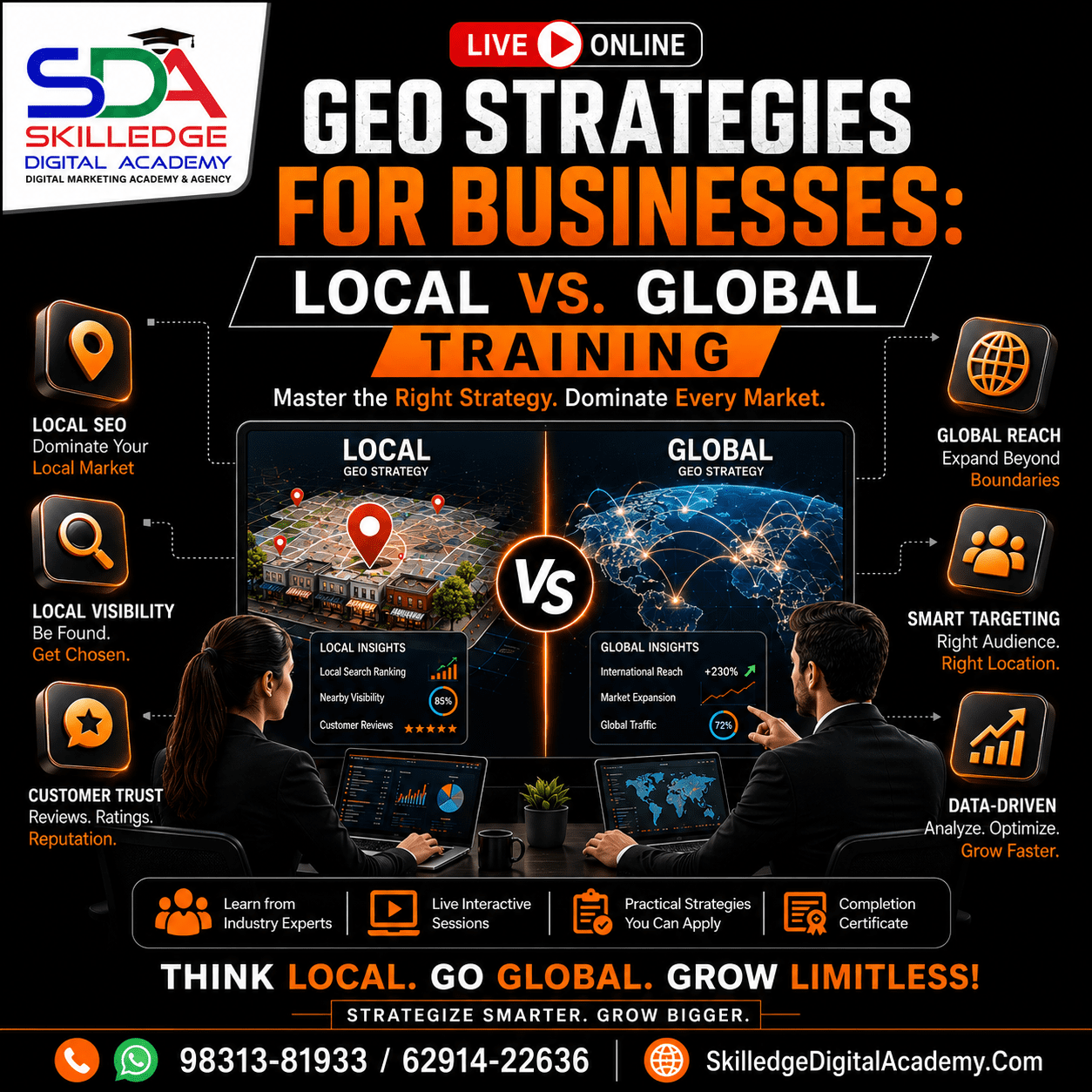
GEO Strategies for Businesses: Local vs. Global
Local Businesses:
Optimize for location-specific questions
Include exact addresses, phone numbers, hours
Reference local reviews and citations
Create content around local events/issues
Global Businesses:
Optimize for universal questions
Include international data and comparisons
Reference global certifications and standards
Create content for multiple regions/languages
At Skilledge Digital Academy, we help students identify their industry’s specific GEO strategies for businesses opportunity. Whether you’re a Kolkata restaurant or a Bangalore SaaS company, there’s a GEO approach that works for you.
GEO Techniques for Website Ranking: Advanced Tactics That Drive Results
Beyond Basics: Advanced GEO Techniques for Website Ranking
Once you’ve mastered the fundamentals, let’s dive into advanced GEO techniques for website ranking that separate amateurs from experts.
Technique 1: Semantic Clustering for AI Understanding
AI models understand content through semantic relationships. Create clusters of related content that reinforce each topic.
How to implement:
Group related questions under main topics
Create hub pages that link to all related content
Use consistent terminology across clusters
Add internal links between related sections
Example: For “digital marketing” topic:
Hub page: “Complete Guide to Digital Marketing in 2026”
Cluster pages: “What is SEO,” “What is GEO,” “How to optimize for AI,” “GEO best practices,” etc.
All pages link back to hub and to each related page
Technique 2: Authority Layering Through Multi-Source Citations
AI models trust content that references multiple authoritative sources.
How to implement:
Cite research from 3+ different sources per major claim
Reference industry standards and frameworks
Include third-party reviews and certifications
Link to original studies (not just summaries)
Example: “Studies show 67% of marketers prioritize content quality (Source A: 2024 HubSpot Report, Source B: 2023 Google Survey, Source C: 2024 McKinsey Analysis).”
Technique 3: Data-Rich Formatting for Easy Extraction
Make your content extraction-friendly for AI models.
How to implement:
Use tables for comparisons
Create bullet lists for features/benefits
Number steps for processes
Bold key metrics and data points
Add summary boxes at section tops
Example format:
text
## Key Statistics for Digital Marketing in 2026
| Metric | Value | Source |
|——–|——-|——–|
| AI search adoption | 68% | Google 2024 |
| Zero-click searches | 60% | SparkToro 2025 |
| GEO citation impact | +47% | StoryChief Case Study |
Technique 4: Question-Answer Density Optimization
AI models look for content that directly answers questions.
How to implement:
Include the exact question in your header
Answer it in the first 3 sentences
Provide supporting details after
Add related sub-questions
Example:
## What is GEO and why does it matter?
GEO is Generative Engine Optimization—the practice of optimizing content for AI search engines like ChatGPT and Google AI Overviews. It matters because 60% of searches now end with zero clicks, and AI is becoming the primary discovery method.
GEO gets you quoted instead of just ranked…
Technique 5: Freshness Signals Through Regular Updates
AI models prefer fresh, updated content.
How to implement:
Update content quarterly with new data
Add “Updated: [Date]” to content
Reference current-year statistics
Include recent case studies and examples
Example: “As of June 2026, 68% of searches use AI overviews (updated from 52% in January 2026).”
At Skilledge Digital Academy, we teach these advanced GEO techniques for website ranking in our advanced modules. Students who master these techniques see 2-3x more AI citations than those using only basics.

Future of GEO in Digital Marketing: What’s Coming Next and How to Prepare
The Trajectory: Where is GEO Heading in 2026-2028?
You’re probably wondering: what’s the future of GEO in digital marketing? Let me give you a clear picture based on current trends and expert analysis.
Trend 1: AI Search Will Dominate Traditional Search
By 2027, experts predict that 75% of searches will use AI-powered responses instead of traditional SERPs. This means GEO will become more important than traditional SEO.
What this means for you:
Invest in GEO now, before it’s mandatory
Don’t abandon SEO entirely (hybrid approach wins)
Prepare for AI-first content strategy
Build authority systems that work across platforms
Trend 2: Multi-Platform AI Ecosystem Will Expand
It’s not just ChatGPT and Google AI Overviews anymore. By 2027, we’ll see:
Microsoft Copilot integration
Amazon AI shopping assistants
Social media AI (Instagram AI, Facebook AI)
Industry-specific AI tools (healthcare AI, legal AI, finance AI)
What this means for you:
Optimize for multiple AI platforms
Create platform-specific content variations
Build universal authority that works everywhere
Test content across emerging AI tools
Trend 3: GEO Metrics Will Become Standard KPIs
Agencies and businesses will start tracking GEO-specific metrics:
AI citation rate
AI visibility score
Brand mention velocity in AI
Cross-platform AI presence
What this means for you:
Start tracking GEO metrics now
Report GEO performance to stakeholders
Build GEO into your marketing dashboard
Hire or train GEO specialists
Trend 4: Content Quality Bar Will Rise Exponentially
AI models will get smarter at detecting low-quality content. The bar for what gets cited will keep rising.
What this means for you:
Invest in data-driven content
Build genuine authority (not just表面 authority)
Create truly original insights
Focus on expertise, not just optimization
Preparing for the Future of GEO in Digital Marketing
Here’s your action plan:
Immediate (Next 30 Days):
Implement basic GEO best practices on existing content
Test your content in 3+ AI platforms
Set up GEO tracking metrics
Short-term (3-6 Months):
Create GEO-optimized content for top 10 questions
Build authority through citations and case studies
Train team on GEO principles
Long-term (6-12 Months):
Develop full GEO strategy for your business
Integrate GEO into all marketing channels
Become recognized authority in your niche
At Skilledge Digital Academy, we’re preparing students for this future. Our curriculum includes the future of GEO in digital marketing so you’re ahead of the curve, not behind it.
GEO Optimization: Putting It All Together Into a Complete Strategy
Building Your Comprehensive GEO Optimization Framework
Now let’s bring everything together into a complete GEO optimization strategy you can implement today.
Phase 1: Foundation (Weeks 1-2)
Audit and Setup:
Audit all existing content for GEO readiness
Identify top 10 questions to target
Set up tracking spreadsheet
Choose 3 AI platforms for testing
Quick Wins:
Optimize 3 highest-value pages using GEO best practices
Add Q&A format to blog posts
Include specific data points in product descriptions
Phase 2: Implementation (Weeks 3-8)
Content Creation:
Create 5 new GEO-optimized articles
Rewrite 10 existing pages with GEO techniques
Build hub-pages for semantic clusters
Authority Building:
Add citations to research studies
Include case studies with data
Reference third-party reviews
Show certifications and licenses
Phase 3: Optimization (Weeks 9-12)
Testing and Refinement:
Test all content in 5+ AI platforms
Identify which pages get cited most
Refine non-cited content
Update with fresh data
Scaling:
Create GEO optimization checklist
Train team on GEO principles
Build GEO into content calendar
Report results to stakeholders
GEO Optimization Checklist for Every Page
Before publishing any content, check:
✅ Q&A format used
✅ Paragraphs are 3-4 sentences, standalone
✅ Specific data included (numbers, dates, percentages)
✅ Concrete examples provided
✅ Authority signals present
✅ Clear formatting (bullets, numbers, bold)
✅ Internal links added
✅ Updated with current-year data
✅ Tested in at least 2 AI platforms
At Skilledge Digital Academy, we walk students through this complete Generative Engine optimization framework in our hands-on projects. You’ll implementations these strategies on your own website and see real results.
GEO Marketing Strategy: Integrating GEO Into Your Overall Marketing Plan
Making GEO Marketing Strategy Work Across All Channels
GEO isn’t a standalone tactic—it’s part of your complete marketing strategy. Here’s how to integrate Generative Engine Optimization marketing strategy across channels.
SEO + GEO: The Hybrid Approach
Don’t abandon SEO. Use both together:
Traditional SEO focuses on:
Keyword rankings
Backlink building
Meta optimization
Technical SEO
GEO focuses on:
AI citations
Authority building
Content clarity
Data richness
The hybrid strategy:
Optimize content for both rankings AND citations
Use SEO keywords naturally in GEO content
Build backlinks that also boost authority for GEO
Maintain technical SEO while implementing GEO structure
Content Marketing + GEO
Every piece of content should be GEO-ready:
Blog posts:
Structure in Q&A format
Include specific data
Add authority citations
Make paragraphs standalone
Product pages:
List exact features and specs
Include prices and comparisons
Reference reviews with numbers
Answer common questions
Email content:
Use clear, specific language
Include data points
Reference case studies
Be authoritative but accessible
Social media:
Share data-rich posts
Answer questions directly
Reference authoritative sources
Use clear formatting
Paid Advertising + GEO
Even paid ads benefit from GEO:
Search ads:
Use specific claims with data
Include exact pricing
Reference certifications
Answer вопросы in ad copy
Social ads:
Show concrete results
Include specific numbers
Reference real customers
Use authoritative language
Brand Building + GEO
GEO is brand building:
Every AI citation = brand awareness
Every citation = trust signal
Every citation = authority building
Every citation = competitive advantage
At Skilledge Digital Academy, we teach students to integrate GEO marketing strategy into their complete marketing plan. Our 3-month program covers SEO, content marketing, paid ads, and GEO—so you get the full picture.

Conclusion: Your GEO Journey Starts Now
The Bottom Line on What is GEO
Let me wrap this up with clarity. What is GEO? It’s Generative Engine Optimization—the practice of structuring your content to get quoted by AI search engines instead of just ranked in traditional search.
SEO gets you ranked. GEO gets you quoted. And in 2026, being quoted is becoming more valuable than being ranked.
We’ve covered everything from GEO for beginners to advanced GEO techniques for website ranking. We’ve explored how does GEO work, the benefits of Generative Engine Optimization, GEO best practices, how to optimize for AI search, GEO strategies for businesses, and the future of GEO in digital marketing.
Your Next Steps
Here’s what you should do right now:
Test your current content in ChatGPT, Google AI Overviews, and Perplexity. Are you getting cited?
Pick 3 pages to optimize using GEO best practices this week.
Add specific data to your content—replace vague statements with concrete numbers.
Structure content in Q&A format for your top 5 questions.
Track your AI citation rate and measure improvement.
Join Skilledge Digital Academy to Master GEO
This is the cutting edge of digital marketing. And at Skilledge Digital Academy, we’re teaching it live, hands-on, in our 3-month program.
Skilledge Digital Academy

Key Features at a Glance
| Feature | Details | Available |
|---|---|---|
| Free Demo Class | Experience a live session before committing | ✓ Yes |
| Live Online Training | Real-time classes with mentor interaction | ✓ Yes |
| 5+ Certifications | Google, Meta, HubSpot, SEMrush & more | ✓ Yes |
| 100% Placement Assistance | Resume review, mock interviews, referrals | ✓ Yes |
| Round the Clock Support | Mentor available 24/7 via WhatsApp & chat | ✓ Yes |
| Interview Preparation | Dedicated sessions + real interview simulations | ✓ Yes |
Training Modules Covered
Our curriculum is built for the 2026 industry:
| Module | What You’ll Master |
| SEO (Search Engine Optimization) | On-page, off-page, technical SEO & keyword strategy |
| SEM (Search Engine Marketing) | Paid search strategy, bidding, Quality Score optimization |
| SMO (Social Media Optimization) | Profile growth, organic reach, platform algorithms |
| SMM (Social Media Marketing) | Campaign strategy, content calendars, community building |
| Facebook & Instagram Ads | Meta Ads Manager, audience targeting, creative testing |
| Google Ads | Search, Display, Shopping, Performance Max campaigns |
| Website Development | WordPress, landing page design, CRO fundamentals |
| Graphic Designing | Canva, Adobe tools, social media creative design |
| Affiliate Marketing | Platforms, commission models, traffic monetization |
| Content Marketing | Blog strategy, copywriting, email marketing, funnels |
| AI Softwares & Tools | ChatGPT, Jasper, Midjourney, automation for marketers |
Enroll in our 3 month live online Digital Marketing training today! Enjoy 90% practical sessions, round-the-clock support, and 100% placement assistance.
Skilledge Digital Academy
📞Phone/WhatsApp:+91 62914-22636 / 98313-81933
📧 Email: edu@skilledgedigitalacademy.com
🌐 Website: www.skilledgedigitalacademy.com