


Listen, I’ve been mentoring digital marketers for over a decade, and if there’s one truth I’ve learned at Skilledge Digital Academy, it’s this: video marketing isn’t just another channel—it’s the language your audience speaks fluently now.
When I first started teaching video marketing back in 2015, businesses treated it as a nice-to-have bonus. Today? If you’re not leveraging Video Advertising, you’re basically shouting into a void while your competitors are having full conversations with their customers. That’s the brutal reality of 2026.
In this guide, I’m going to show you exactly what is Video Advertising from a strategist’s perspective—not the surface-level definition you’ll find on the first page of Google, but the real mechanics that separate brands that win from those that just post content and hope for the best. We’ll dive deep into video marketing examples that actually work, build a video content marketing strategy that converts, and give you the video marketing metrics that matter (not the vanity ones).
By the time you finish reading, you’ll understand video marketing well enough to architect campaigns that drive real revenue, not just views. And if you’re serious about mastering this, we’ll cover how Skilledge Digital Academy trains students to become the Video Advertising companies are fighting to hire.
Let’s get into it.
Why Understanding What is Video Marketing Changes Everything for Your Business
Here’s the thing most gurus won’t tell you: video marketing isn’t about making pretty videos. It’s about strategic communication that moves people through a psychological journey from stranger to customer to advocate.
When I teach this at Skilledge Digital Academy, I start with a hard truth: 89% of consumers want to see more video content from brands [cite industry data]. But here’s the kicker—only 34% of businesses have a documented video content marketing strategy. That gap? That’s your opportunity.
The Psychology Behind Why Video Advertising Works Better Than Static Content
Your brain processes video 60,000 times faster than text. When you combine visual, auditory, and emotional stimuli, you create what neuroscientists call “neural coupling”—the viewer’s brain literally mirrors the storyteller’s brain activity. That’s why video marketing feels so different from reading a blog post or scrolling through images.
Think about the last time you watched a compelling brand video. Did you feel something? Maybe inspiration, curiosity, or even urgency? That’s not accidental. That’s digital video marketing strategy at work.
How Video Advertising Fits Into the Modern Customer Journey
Traditional marketing funnels are dead. The modern customer journey is messy, non-linear, and heavily influenced by video at every stage. Here’s what I teach my students:
Awareness stage: Short-form video marketing on TikTok, Reels, and YouTube Shorts introduces your brand
Consideration stage: Longer explainer videos and case studies build trust
Decision stage: Product demos and testimonials remove purchase friction
Retention stage: Educational video content keeps customers engaged
Advocacy stage: User-generated video marketing examples turn customers into promoters
Most businesses mess this up by using the same video advertising approach for every stage. Don’t be most businesses.
Video Marketing Defined: Beyond the Basic Definition You’ve Heard Before
So what is video advertising really? Let me give you the definition I use when mentoring students at Skilledge Digital Academy:
V m is the strategic creation, distribution, and optimization of moving visual content designed to achieve specific business objectives—whether that’s brand awareness, lead generation, customer education, or revenue growth—measured through data-driven video advertising metrics and refined through continuous testing.
Notice I didn’t say “making videos for social media.” That’s tactical, not strategic.
The Four Pillars of Effective Video Marketing
Every successful video marketing campaign I’ve analyzed (and I’ve analyzed hundreds) rests on these four pillars:
1. Strategic Objectives
Your video marketing objectives must tie directly to business outcomes. “Get more views” isn’t an objective—it’s a vanity metric. “Generate 500 qualified leads from product demo videos” is an objective.
2. Audience-Centric Content
The best video content marketing strategy starts with deep audience research, not creative ideas. What keeps your audience up at night? What questions do they ask? What format do they consume when they’re ready to buy?
3. Platform-Specific Distribution
A LinkedIn v m strategy looks completely different from a TikTok strategy. Each v m platform has its own algorithm, audience behavior, and content expectations.
4. Measurement and Optimization
If you can’t measure it, you can’t improve it. V m metrics like view-through rate, engagement rate, and conversion rate tell you what’s working so you can double down.
Video Marketing Examples That Prove Strategy Beats Random Content Creation
Let’s get concrete. I’m going to share video advertising examples that actually moved the needle for real businesses—not the curated case studies you see on agency homepages, but the raw, unfiltered truth about what works.
Example 1: Dollar Shave Club’s Launch Video That Changed Everything
Remember Dollar Shave Club’s 2012 launch video? Cost: $4,500. Views in 48 hours: 12,000. Orders: 12,000. Server crashes: Multiple.
Here’s why this video advertising example still matters in 2026:
Clear objective: Generate initial customers and brand awareness
Perfect audience understanding: Men tired of overpriced razors
Platform alignment: YouTube (long-form, search-driven)
Unique value proposition: Delivered in 90 seconds with humor
Their digital video marketing strategy was simple: be memorable, be clear, be different. The result? Sold to Unilever for $1 billion in 2016.
Example 2: HubSpot’s Educational Video Content Marketing Strategy
HubSpot doesn’t sell software—they sell education. Their video content marketing strategy includes:
Free certification courses with video modules
Weekly YouTube tutorials on marketing topics
Product demo videos embedded in blog posts
Webinar recordings repurposed as short clips
Result? Over 7 million monthly website visitors and 100,000+ customers. Their Video Advertising funnel converts viewers into leads through gated educational content.
Example 3: Duolingo’s TikTok-First Video Advertising Approach
Duolingo’s unhinged owl mascot became a video advertising phenomenon on TikTok. Key tactics:
Behind-the-scenes content showing the team
Trending audio and challenges
Community responses to comments
No hard selling, just entertainment
Their video promotion platforms strategy focused exclusively on where Gen Z spends time, resulting in 45+ million followers and 2 billion+ video views.
What These Video Marketing Examples Teach Us
Video marketing objectives must be crystal clear before production starts
Video content marketing strategy should align with where your audience actually spends time
Authenticity beats production value in most cases
Consistency on video advertising platforms matters more than perfection

Building Your Video Content Marketing Strategy: A Step-by-Step Framework
At Skilledge Digital Academy, I teach my students a proven framework for building a video content marketing strategy that actually works. Here it is:
Step 1: Define Your Video Marketing Objectives
Your video marketing objectives should follow the SMART framework:
Specific: “Generate leads” → “Generate 200 qualified leads from product demo videos”
Measurable: Trackable through video marketing metrics
Achievable: Realistic given your resources
Relevant: Tied to business goals
Time-bound: “Within 90 days”
Common video advertising objectives include:
Brand awareness (measured by reach, impressions)
Lead generation (measured by form submissions, downloads)
Customer education (measured by completion rates, support ticket reduction)
Sales conversion (measured by revenue, conversion rate)
Customer retention (measured by churn rate, engagement)
Step 2: Map Video Content to Your Video Marketing Funnel
Your v m funnel should have distinct content for each stage:
Top of Funnel (Awareness)
Short-form content (15-60 seconds)
Entertainment or educational hooks
Platforms: TikTok, Instagram Reels, YouTube Shorts
metrics: Views, reach, shares
Middle of Funnel (Consideration)
Explainer videos (2-5 minutes)
Problem-solution format
Platforms: YouTube, LinkedIn, Website
Video Advertising metrics: Watch time, engagement rate, click-through rate
Bottom of Funnel (Decision)
Product demos, case studies, testimonials (3-10 minutes)
Social proof and risk reversal
Platforms: Website, Email, Sales calls
Video Advertising metrics: Conversion rate, demo requests, sales
Post-Purchase (Retention & Advocacy)
Onboarding videos, tutorials, community content
Platforms: Email, Customer portal, Private communities
Video Advertising: Retention rate, NPS, user-generated content
Step 3: Choose Your Video Marketing Platforms Strategically
Don’t be everywhere. Be where your audience is. Here’s my breakdown of video marketing platforms:
Your digital video advertising strategy should focus on 2-3 video promotion platforms maximum when you’re starting.
Step 4: Develop Your Video Marketing Best Practices
Every successful video marketing campaign follows certain v m best practices:
Production Quality
Audio quality matters more than video quality
First 3 seconds determine whether people keep watching
Add captions (85% of videos are watched without sound)
Keep it mobile-first (60%+ views are on mobile)
Content Strategy
One core message per video
Clear call-to-action (CTA) in every video
Hook in the first sentence
Tell stories, don’t just present information
Distribution
Publish consistently (algorithm preference)
Recycle content across formats
Embed videos in blog posts (increases SEO by 157%)
Promote through email and paid ads
Measurement
Track video marketing metrics weekly
A/B test thumbnails and titles
Analyze drop-off points to improve retention
Calculate ROI based on video marketing objectives
The Video Marketing Funnel: How to Convert Viewers Into Customers
Most businesses leak money because they don’t understand the video marketing funnel. Let me show you how to plug those leaks.
Understanding Each Stage of Your Video Marketing Funnel
Awareness Stage: The Hook
At this stage, your video advertising goal is to stop the scroll. Your content should:
Address a pain point immediately
Use eye-catching visuals in the first frame
Be easily consumable (short, punchy)
Encourage engagement (likes, shares, comments)
Example: A fitness brand posts a 15-second Reel showing “3 mistakes killing your gains” with a hook like “Stop doing push-ups like this.”
Consideration Stage: The Build
Now you’re building trust. Your video content marketing strategy should:
Provide genuine value without asking for anything
Show expertise through detailed explanations
Address common objections
Include social proof
Example: The same fitness brand posts a 5-minute YouTube video “Complete Beginner’s Guide to Push-Up Form” with links to their free workout plan.
Decision Stage: The Close
Time to convert. Your video marketing should:
Remove risk (guarantees, testimonials)
Show clear next steps
Create urgency (limited-time offers)
Make the purchase process obvious
Example: A 3-minute product demo showing exactly how their fitness app works with a 14-day free trial CTA.
Retention Stage: The Delight
Keep them coming back. Your video advertising should:
Provide ongoing value
Build community
Reward loyalty
Encourage referrals
Example: Weekly workout videos sent via email, exclusive content for subscribers, customer success story features.
Calculating Video Marketing Funnel Conversion Rates
Here’s what I teach at Skilledge Digital Academy about video marketing metrics at each stage:
If your video advertising funnel conversion rates are below these benchmarks, you need to diagnose where the leak is and fix it before spending more on production.
Video Marketing Metrics That Actually Matter (Stop Vanity Metrics)
I’ve seen too many marketers celebrate 1 million views while their bank account stays empty. Here’s the truth: v m metrics only matter if they tie to business outcomes.
The 7 Video Marketing Metrics You Should Track Daily
1. View-Through Rate (VTR)
Formula: (Completed views ÷ Total impressions) × 100
Benchmark: 25-40% for most content
What it tells you: Is your content engaging enough to watch?
2. Average Watch Time
Formula: Total watch time ÷ Total views
Benchmark: 50%+ of video length
What it tells you: Where are people dropping off?
3. Engagement Rate
Formula: (Likes + Comments + Shares) ÷ Views × 100
Benchmark: 3-8% depending on platform
What it tells you: Is your content resonating emotionally?
4. Click-Through Rate (CTR)
Formula: (Clicks ÷ Views) × 100
Benchmark: 2-5% for embedded CTAs
What it tells you: Is your CTA compelling?
5. Conversion Rate
Formula: (Conversions ÷ Clicks) × 100
Benchmark: 10-30% for landing pages
What it tells you: Is your offer aligned with video content?
6. Cost Per Acquisition (CPA)
Formula: Total video marketing spend ÷ New customers acquired
Benchmark: Varies by industry (calculate your break-even)
What it tells you: Is your v m profitable?
7. Return on Ad Spend (ROAS)
Formula: Revenue from video ÷ Ad spend on video
Benchmark: 3:1 minimum for paid video
What it tells you: Is your paid video advertising working?
How to Calculate Video Marketing ROI
Here’s the formula I use when mentoring students at Skilledge Digital Academy:
Total Video Costs include:
Production (equipment, software, crew)
Talent (actors, voice-over, on-screen hosts)
Distribution (ad spend, promotion)
Time (team hours, project management)
Example:
Revenue from video campaign: $50,000
Total costs: $15,000
ROI: (($50,000 – $15,000) ÷ $15,000) × 100 = 233%
If your video advertising ROI is negative, you need to either increase revenue (better conversion optimization) or decrease costs (more efficient production).
Digital Video Marketing Strategy: Integrating Video Across Your Entire Marketing Stack
Here’s what separates amateur Video Advertising from professional digital video marketing strategy: integration.
How Video Marketing Fits Into Your Overall Marketing Mix
Your Video Advertising shouldn’t exist in a silo. It should amplify every other channel:
Video + SEO
Embed videos in blog posts (increases time-on-page by 88%)
Create video sitemaps for Google indexing
Optimize video titles, descriptions, and transcripts for search
Result: 157% more organic traffic from search [source: Forrester]
Video + Email Marketing
Include video thumbnails in emails (increases CTR by 300%)
Use video in welcome sequences
Send personalized video messages for high-value leads
Result: 26% higher email open rates
Video + Social Media
Repurpose long-form content into short clips
Use platform-native video (not cross-posted)
Engage with comments within first hour of posting
Result: 2x higher engagement than static posts
Video + Paid Advertising
Use top-performing organic videos as ad creative
Retarget video viewers with conversion ads
Test multiple hooks in paid campaigns
Result: 30% lower cost per acquisition
Video + Sales
Embed product demos in sales emails
Use video proposals instead of PDFs
Record personalized Loom videos for prospects
Result: 40% shorter sales cycles
The Technology Stack for Modern Video Advertising
You don’t need Hollywood equipment, but you do need the right tools. Here’s what I recommend for Skilledge Digital Academy students starting their digital video marketing strategy:
Production Tools
Camera: iPhone 15 Pro or Sony ZV-E10 ($1,000-1,500)
Microphone: Rode VideoMic or Blue Yeti ($100-200)
Lighting: Neewer 2-Pack LED ($80)
Editing: DaVinci Resolve (free) or Final Cut Pro ($299)
Screen recording: Loom or Camtasia ($15-30/month)
Distribution Tools
Hosting: YouTube (free), Wistia (professional, $19/month)
CMS: WordPress with video plugins
Email: Mailchimp or ConvertKit with video support
Analytics: Google Analytics 4 + platform native analytics
Optimization Tools
Thumbnail design: Canva Pro ($12.99/month)
SEO: TubeBuddy or VidIQ for YouTube ($9-49/month)
captions: Otter.ai or Rev ($0.25/minute)
A/B testing: Google Optimize (free) or Optimizely

Video Marketing Best Practices: The Rules I Never Break When Teaching Students
After mentoring hundreds of students at Skilledge Digital Academy and analyzing thousands of campaigns, these are the video marketing best practices I never compromise on:
Best Practice #1: Hook Within 3 Seconds or Lose Them Forever
The average attention span is 8 seconds (less than a goldfish). Your first 3 seconds determine everything.
Hooks that work:
“Stop doing [common mistake] right now”
“Here’s what nobody tells you about [topic]”
“I tried [method] for 30 days—here’s what happened”
“This one mistake is costing you [money/time/results]”
Hooks that fail:
Long intros with logos
“Hey guys, welcome back to my channel”
Slow builds without immediate value
Generic greetings without context
Best Practice #2: Optimize for Sound-Off Viewing
85% of Facebook videos and 60% of Instagram videos are watched without sound. Your Video Advertising must work silently.
How to optimize:
Add burned-in captions (not just platform captions)
Use visual storytelling that makes sense without audio
Include text overlays for key points
Don’t rely on audio-only cues
Best Practice #3: One Video, One Message, One CTA
Confusion kills conversion. Every Video Advertising piece should have:
One core message (what do you want them to remember?)
One emotional takeaway (how do you want them to feel?)
One clear CTA (what do you want them to do next?)
Example:
Message: “Our app saves 10 hours/week on bookkeeping”
Emotion: Relief from stress
CTA: “Start your 14-day free trial”
Best Practice #4: Test, Measure, Iterate Relentlessly
Your first Video Advertising campaign won’t be perfect. Your tenth will be. Here’s my testing framework:
Test these variables:
Thumbnails (3-5 variations)
Titles (hook-driven vs. benefit-driven)
Video length (short vs. long)
Hooks (problem vs. solution vs. story)
CTAs (soft vs. hard)
Posting times (morning vs. evening)
Measure weekly:
Which videos perform best?
Where do people drop off?
What topics get most engagement?
Which platforms drive conversions?
Iterate monthly:
Double down on winning formats
Kill underperforming content types
Refine your video marketing objectives
Update your video content marketing strategy
Best Practice #5: Authenticity Beats Production Value
I’ve seen $10 videos outperform $10,000 productions. Why? Authenticity connects.
When to keep it raw:
Behind-the-scenes content
Customer testimonials
Founder stories
Quick tips and hacks
Response to trends
When to invest in production:
Product launches
Brand campaigns
High-stakes sales videos
Corporate communications
Evergreen educational content
Video Marketing Platforms Compared: Where Should You Actually Focus Your Energy?
Not all video advertising platforms are created equal. Here’s my no-BS breakdown of where to focus based on your business type.
B2B Companies: LinkedIn + YouTube
LinkedIn Video Marketing
Best for: Thought leadership, company culture, product demos
Ideal length: 1-3 minutes
Posting frequency: 2-3 times/week
Video Advertising metrics to track: Engagements, profile views, lead form submissions
Video marketing best practices: Professional tone, data-driven content, clear B2B value proposition
YouTube B2B Strategy
Best for: Educational content, tutorials, webinars
Ideal length: 5-15 minutes
Posting frequency: 1-2 times/week
Video Advertising to track: Watch time, subscriber growth, conversion to trial
Video marketing best practices: SEO-optimized titles, detailed descriptions, timestamps, playlists
B2C Brands: TikTok + Instagram + YouTube Shorts
TikTok Video Marketing
Best for: Viral reach, brand awareness, younger demographics
Ideal length: 15-60 seconds
Posting frequency: 1-3 times/day
Video Advertising metrics to track: Views, shares, follower growth, profile clicks
Video marketing best practices: Trending audio, authentic tone, quick cuts, no hard selling
Instagram Reels Strategy
Best for: Lifestyle brands, visual products, community building
Ideal length: 15-90 seconds
Posting frequency: 4-7 times/week
Video Advertising metrics to track: Saves, shares, profile visits, website clicks
Video advertising best practices:Aesthetic consistency, carousel follow-ups, strong hooks
YouTube Shorts
Best for: Evergreen content, search-driven discovery
Ideal length: 15-60 seconds
Posting frequency: 3-5 times/week
Video Advertising metrics to track: Views, retention rate, subscriber conversion
Video marketing best practices: Vertical format, quick value delivery, link to long-form content
E-commerce: YouTube + Instagram + Facebook
E-commerce Video Marketing Strategy
Product showcases: 30-60 seconds
Unboxing videos: 2-5 minutes
Customer testimonials: 1-3 minutes
How-to videos: 3-10 minutes
Video marketing funnel: Awareness (Reels) → Consideration (YouTube) → Decision (Product page videos)
Local Businesses: Google Business Profile + Facebook + Instagram
Local Video Marketing
Google Business Profile videos: 30 seconds (showcases your business)
Facebook: Community-focused content, events
Instagram: Behind-the-scenes, team introductions
Video advertising objectives: Foot traffic, phone calls, direction requests
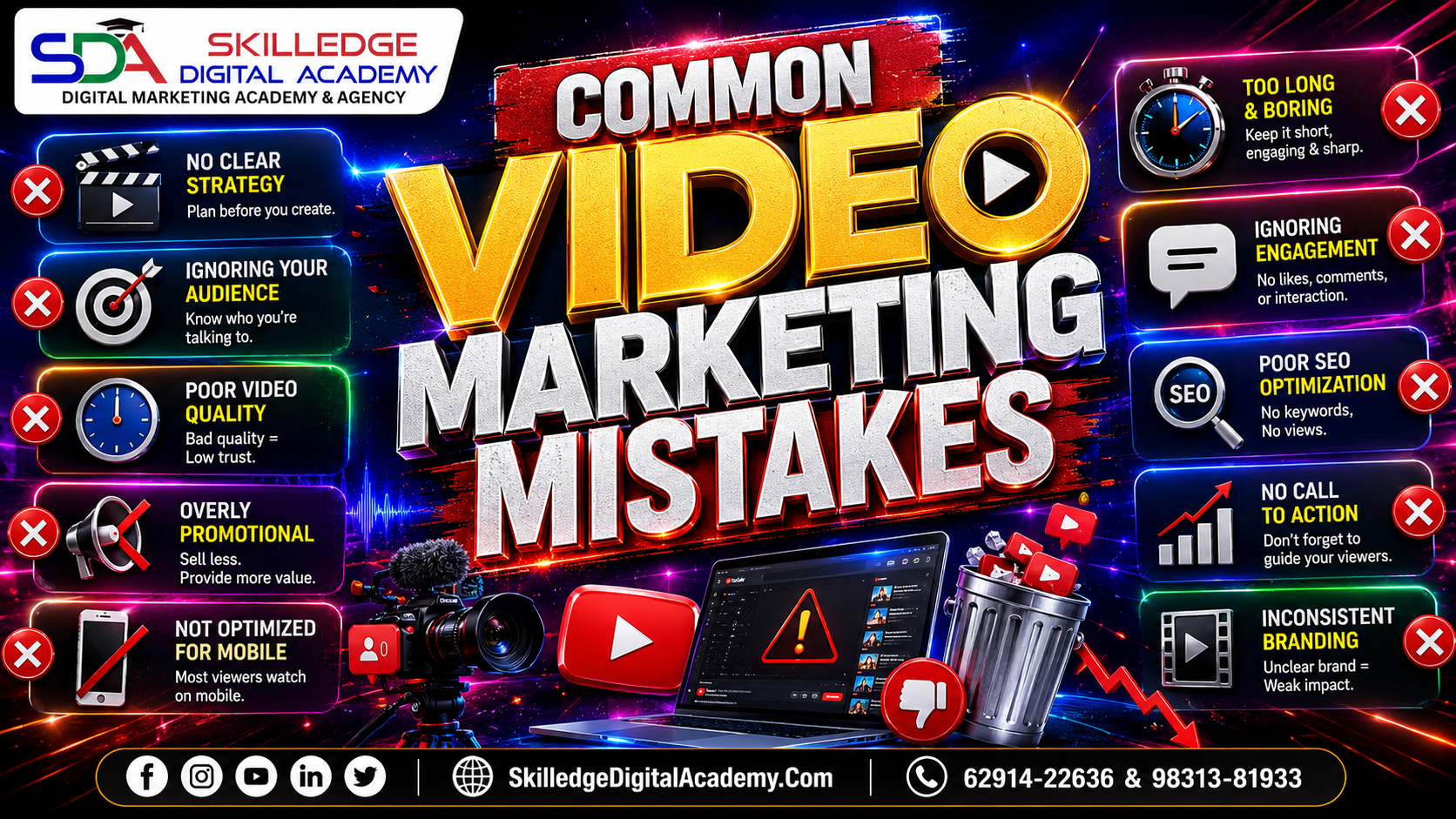
Common Video Marketing Mistakes (And How to Fix Them Before They Cost You)
I’ve seen these Video Advertising mistakes cost businesses thousands. Don’t be them.
Mistake #1: No Clear Video Marketing Objectives
Problem: “Let’s just make some videos and see what happens”
Fix: Define video marketing objectives before production:
What business outcome do you want?
Who is this for?
What action should they take?
How will you measure success?
Mistake #2: Wrong Platform for Your Audience
Problem: B2B SaaS company posting exclusively on TikTok
Fix: Match video promotion platforms to where your audience actually is:
Research where your ideal customers spend time
Study competitors’ successful platforms
Test 2-3 platforms before committing
Double down on what works
Mistake #3: Ignoring Video Marketing Metrics
Problem: Celebrating 100K views with zero conversions
Fix: Track meaningful video marketing metrics:
Set up conversion tracking before launching
Connect video analytics to CRM
Calculate ROI monthly
Pivot based on data, not hunches
Mistake #4: Inconsistent Publishing Schedule
Problem: Posting 10 videos in one week, then nothing for a month
Fix: Create a sustainable video content marketing strategy:
Start with 1 video/week consistently
Batch-produce content monthly
Use a content calendar
Plan for seasons and holidays
Mistake #5: Poor Audio Quality
Problem: Viewers can’t hear what you’re saying
Fix: Invest in audio before video:
Buy a $100 microphone
Record in quiet spaces
Use noise reduction software
Always do audio checks
Mistake #6: No Call-to-Action
Problem: Great video, no direction for what’s next
Fix: Every video advertising piece needs a CTA:
Verbal CTA in the video
Text overlay CTA
Link in description/bio
End screen with next step
How Skilledge Digital Academy Trains You to Master Video Advertising
Here’s where I’m going to be completely transparent: video advertising is hard to master alone. You need mentorship, practical experience, and feedback from people who’ve done it successfully.
At Skilledge Digital Academy, we don’t just teach video advertising—we immerse you in it. Here’s what makes our approach different:
Our Video Marketing Curriculum Breakdown
Month 1: Foundations
Understanding what is video marketing strategically
Setting video marketing objectives aligned to business goals
Choosing the right video marketing platforms
Basic equipment and production setup
Video marketing best practices for beginners
Month 2: Strategy & Production
Building a video content marketing strategy
Scriptwriting and storyboarding
Filming and editing fundamentals
Creating a video marketing funnel
Platform-specific optimization (YouTube, TikTok, Instagram, LinkedIn)
Month 3: Advanced Tactics & ROI
Digital video promotion strategy integration
Advanced video advertising metrics and analytics
Paid video advertising (YouTube Ads, Meta Ads)
A/B testing and optimization
Calculating video marketing ROI
Portfolio building with real client projects
What Sets Skilledge Digital Academy Apart
90% Practical Sessions
You’ll create 20+ videos during our 3-month program. Not watch videos about videos—actually make them.
Round-the-Clock Support
Stuck on editing? Need feedback on your video marketing strategy? Our mentors are available anytime.
Real Client Projects
You’ll work with actual businesses, creating video marketing examples for their portfolios while building yours.
100% Placement Assistance
V m are in demand. We connect you with companies actively hiring.
Industry-Updated Content
Our curriculum changes monthly based on what’s working in Video Advertising right now, not what worked 3 years ago.
Student Success Stories
Meet Rajesh, a Skilledge Digital Academy graduate:
Before: Worked in traditional marketing, no video experience
After 3 months: Created 15 video marketing campaigns for 3 clients
Result: Hired as video advertising Specialist at $60,000/year
Meet Priya:
Before: Freelance graphic designer
After mastering video content marketing strategy: Added video services
Result: 3x income increase, working with 5 retainer clients
These aren’t exceptions. This is what happens when you learn video advertising the right way.
The Future of Video Advertising: What’s Coming in 2026 and Beyond
Let me share what I’m seeing on the horizon for Video Advertising . If you’re going to stay ahead, you need to know where the industry is going.
Emerging Video Marketing Trends for 2026
1. AI-Powered Video Production
Tools like Synthesia and Pictory create videos from text
AI editing reduces production time by 70%
Video Advertising becomes accessible to everyone
Impact: Quality differentiation becomes more important
2. Interactive Video Experiences
Shoppable videos (click products within video)
Choose-your-own-adventure storytelling
Live Q&A integration during uploads
Video marketing funnel becomes bidirectional
3. Vertical Video Dominance
94% of videos are now watched vertically [source: industry data]
All video marketing platforms prioritizing vertical content
Video content marketing strategy must be mobile-first
Horizontal videos becoming secondary
4. Hyper-Personalization at Scale
Dynamic video content based on viewer data
Personalized thumbnail optimization
Video advertising metrics used to customize next video
AI-generated variations for A/B testing
5. Short-Form Longevity
Despite short-form dominance, long-form seeing resurgence for depth
Vm strategy now requires both
YouTube Shorts driving traffic to 10+ minute videos
Video marketing objectives determine format

How to Future-Proof Your Video Marketing Strategy
Stay platform-agnostic: Don’t build your entire digital video advertising strategy on one platform
Invest in transferable skills: Scriptwriting, storytelling, and strategy work everywhere
Embrace AI but don’t rely on it: Use tools to enhance, not replace, creativity
Focus on data literacy: Understanding video marketing metrics will become more valuable
Build a personal brand: Your reputation transcends any single platform
Action Plan: Your First 30 Days in Video Marketing
Ready to start? Here’s exactly what I want you to do in your first 30 days. This is the same plan I give Skilledge Digital Academy students.
Week 1: Foundation Setup
Day 1-2: Define Your Video Marketing Objectives
Write down 3 specific video marketing objectives
Tie each to a business outcome
Choose 1 primary Video Advertising metric for each
Day 3-4: Choose Your Video Advertising Platforms
Research where your audience spends time
Select 2 video marketing platforms to focus on
Study 5 competitors on each platform
Day 5-7: Set Up Your Equipment
Purchase basic equipment (phone + mic + lighting)
Set up recording space
Install editing software
Create brand templates (intro, outro, lower thirds)
Week 2: Content Planning
Day 8-10: Develop Your Video Content Marketing Strategy
Map content to your video marketing funnel
Create a 30-day content calendar
Script your first 5 videos
Plan your video advertising distribution strategy
Day 11-14: Batch Produce Your First Videos
Film 3-5 videos in one session
Edit and optimize for each platform
Add captions and thumbnails
Schedule publication
Week 3: Launch & Learn
Day 15-21: Publish and Promote
Publish according to your calendar
Promote through email and social
Engage with every comment within 1 hour
Track video advertising metrics daily
Day 21: Analyze First Week of Data
Review which videos performed best
Identify drop-off points
Note what hooks worked
Plan adjustments for next week
Week 4: Optimize and Scale
Day 22-25: Double Down on Winners
Create follow-up videos to top performers
Repurpose best content into new formats
Test different thumbnails and titles
Increase posting frequency if metrics are strong
Day 26-30: Plan Month 2
Review overall video advertising performance
Calculate初步 ROI
Refine video marketing objectives
Invest in better equipment if profitable
Key milestone: By day 30, you should have 10+ videos published, clear Video Advertising metrics data, and a refined video content marketing strategy.
Frequently Asked Questions About Video Advertising
What is video Advertising in simple terms?
V m is using moving visual content (videos) to achieve business goals like brand awareness, lead generation, or sales. It’s not just making videos—it’s strategically creating, distributing, and optimizing video content to reach specific video marketing objectives.
How much does video advertising cost?
You can start Video Advertising with $200-500 for basic equipment (phone you likely already have, microphone, lighting). Production costs range from $0 (DIY) to $10,000+ (professional agency). The key is starting small, measuring v m metrics, and scaling what works.
How long should my videos be?
It depends on your video marketing funnel stage:
Awareness: 15-60 seconds (short-form)
Consideration: 2-5 minutes (explainer)
Decision: 3-10 minutes (demo, testimonial)
The average optimal length is 2 minutes for most content

Which video marketing platform is best for beginners?
YouTube is best for beginners because:
Free to use
Search-driven (people actively looking for your content)
Long content lifespan
Kingdom of video marketing examples to study
Clear video marketing metrics in analytics
How do I measure Video Promotion success?
Track these video advertising metrics:
View-through rate (engagement)
Average watch time (retention)
Click-through rate (interest)
Conversion rate (action)
ROI (profitability)
Your video marketing objectives determine which metrics matter most.
How often should I post videos?
Consistency beats frequency. Start with:
1 video/week for long-form (YouTube)
3-5 videos/week for short-form (TikTok, Reels)
Adjust based on what your Video Advertising show works
Can I do video promotion without showing my face?
Absolutely. Video marketing examples without faces include:
Screen recordings (tutorials)
Animation/explainer videos
Product showcases
Slideshow with voice-over
B-roll footage with narration
What’s the biggest Video Advertising mistake beginners make?
Not defining video marketing objectives before creating content. They make videos without knowing what they’re trying to achieve, then can’t measure success or improve their digital video marketing strategy.

Ready to Master Video Advertising with Expert Mentorship?
Look, I’ve given you the roadmap. You now understand what is Video Advertising from a strategic perspective, not just a tactical one. You know how to build a video content marketing strategy, create a video marketing funnel, choose the right video marketing platforms, track meaningful video promotionmetrics, and apply video marketing best practices.
But here’s the truth: knowing isn’t the same as doing. The gap between understanding Video Advertising and executing it successfully is where most people get stuck. They need accountability, feedback, and real-world experience.
That’s exactly what we provide at Skilledge Digital Academy.
When you join our program, you’re not just getting a course—you’re getting a mentor (me), a community of ambitious marketers, and a proven system for mastering Video Advertising while building a portfolio that gets you hired.
Skilledge Digital Academy

Key Features at a Glance
| Feature | Details | Available |
|---|---|---|
| Free Demo Class | Experience a live session before committing | ✓ Yes |
| Live Online Training | Real-time classes with mentor interaction | ✓ Yes |
| 5+ Certifications | Google, Meta, HubSpot, SEMrush & more | ✓ Yes |
| 100% Placement Assistance | Resume review, mock interviews, referrals | ✓ Yes |
| Round the Clock Support | Mentor available 24/7 via WhatsApp & chat | ✓ Yes |
| Interview Preparation | Dedicated sessions + real interview simulations | ✓ Yes |
Training Modules Covered
Our curriculum is built for the 2026 industry:
| Module | What You’ll Master |
| SEO (Search Engine Optimization) | On-page, off-page, technical SEO & keyword strategy |
| SEM (Search Engine Marketing) | Paid search strategy, bidding, Quality Score optimization |
| SMO (Social Media Optimization) | Profile growth, organic reach, platform algorithms |
| SMM (Social Media Marketing) | Campaign strategy, content calendars, community building |
| Facebook & Instagram Ads | Meta Ads Manager, audience targeting, creative testing |
| Google Ads | Search, Display, Shopping, Performance Max campaigns |
| Website Development | WordPress, landing page design, CRO fundamentals |
| Graphic Designing | Canva, Adobe tools, social media creative design |
| Affiliate Marketing | Platforms, commission models, traffic monetization |
| Content Marketing | Blog strategy, copywriting, email marketing, funnels |
| AI Softwares & Tools | ChatGPT, Jasper, Midjourney, automation for marketers |
Enroll in our 3 month live online Digital Marketing training today! Enjoy 90% practical sessions, round-the-clock support, and 100% placement assistance.
Skilledge Digital Academy
📞 Phone/WhatsApp: +91 62914-22636 / 98313-81933
📧 Email: edu@skilledgedigitalacademy.com
🌐 Website: www.skilledgedigitalacademy.com