
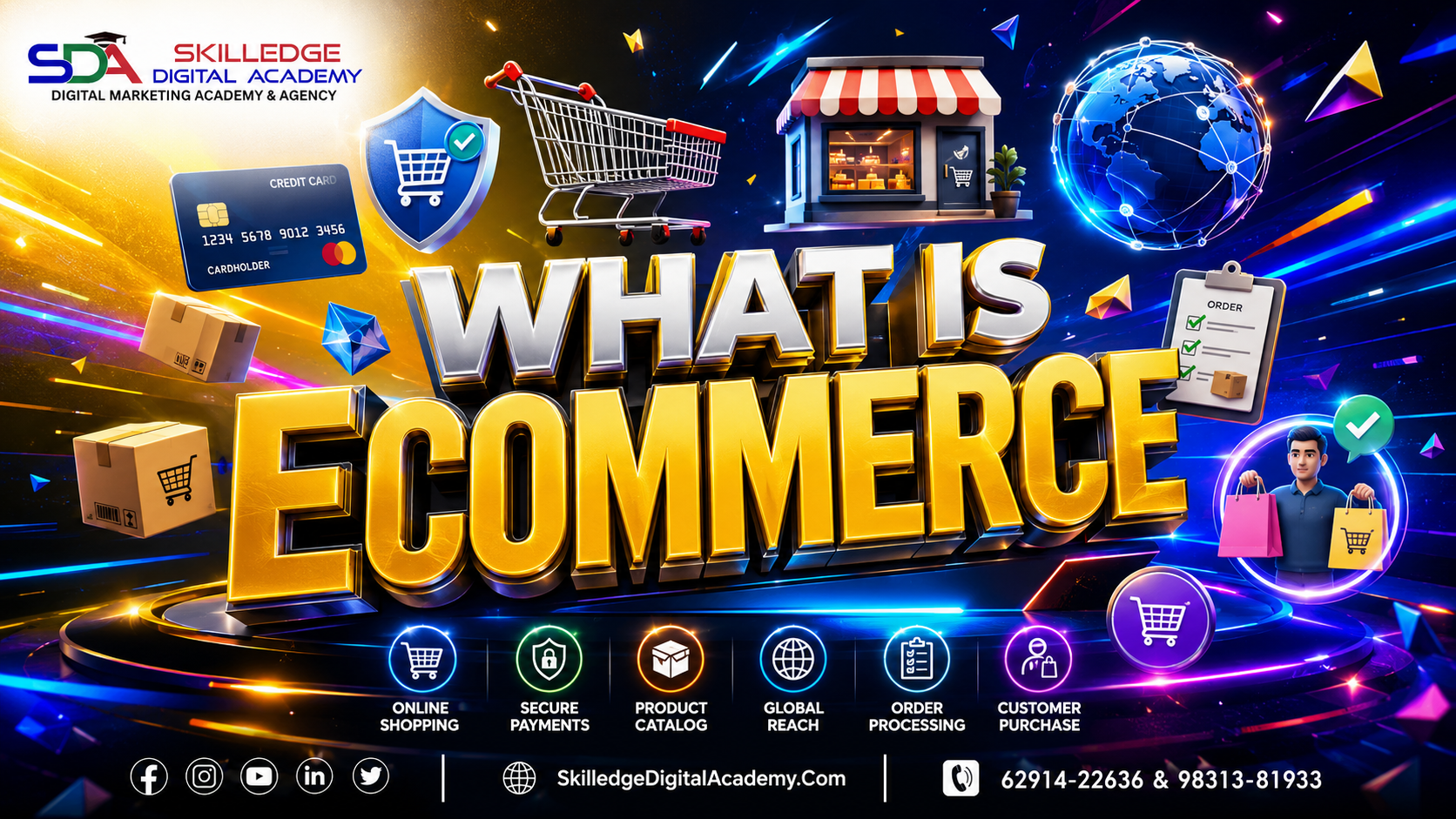
If you’ve ever wondered what is ecommerce, you’re not alone. But here’s the mentor truth: what is ecommerce isn’t just “selling online.” It’s the operating system for modern commerce—an interconnected ecosystem of platforms, data, logistics, payments, personalization, and trust that lets a founder in Kolkata sell handmade spices to a customer in Toronto, while a SaaS startup in Bangalore ships subscriptions to enterprises in London.
In 2026, global ecommerce hit $6.88 trillion, and it’s no longer a “channel.” It’s the default. Yet most guides still explain what is ecommerce like it’s 2010: a website, a cart, checkout. That’s incomplete. Today, what is ecommerce business really means mastering a stack that includes AI-driven personalization, headless architecture, retail media networks, and sustainability-driven logistics.
At Skilledge Digital Academy, we teach what is ecommerce through real campaigns, live stores, and data-backed strategy—not theory. In this guide, I’ll walk you through what is an ecommerce website, what is an ecommerce platform, what is ecommerce marketing, and how to pick the best ecommerce platform for small business or the best ecommerce platform for startups based on your actual goals.
By the end, you’ll see what is ecommerce not as a definition, but as a playbook you can execute.
What Is Ecommerce Really? The 2026 Commerce OS — From Website+Cart to Full Operating System
Ecommerce today is no longer just a website and a shopping cart; it’s a commerce operating system that runs product discovery, conversion, fulfilment, and customer relationships end-to-end. The 2026 Commerce OS combines storefront, headless APIs, inventory and order orchestration, payments, CX automation, and analytics into a unified stack so teams can move faster and scale reliably. Instead of treating the site as the sole revenue driver, modern merchants design pipelines: content and social to attract, data-driven product pages to convert, automated fulfilment and returns to delight, and lifecycle orchestration (email, SMS, loyalty) to compound value.
Key shifts: composable tech (pick best-of-breed services via APIs), real-time personalization (contextual offers and dynamic pricing), and ownership of first-party data to reduce ad dependency. Operational rigor matters: unified inventory, SLAs for fulfillment, and profit-first metrics (CAC, LTV, contribution margin). The Commerce OS mindset makes growth repeatable: feature rollouts become experiments, customer insights feed product roadmaps, and automation reduces manual firefighting. Brands that adopt this systems view win by delivering consistent experiences at scale and turning ecommerce into the company’s primary growth engine.
Why the Old “What is Ecommerce” Definition Fails Beginners
Most guides stop at “buying and selling over the internet.” But if you build your strategy on that, you’ll hit three walls:
Platform lock-in: You pick what is an ecommerce platform without knowing composable options, then can’t scale.
Marketing myopia: You treat what is ecommerce marketing like “run Facebook ads,” ignoring retail media, SEO, and lifecycle.
Experience debt: You launch what is an ecommerce website with slow load times, bad mobile UX, and no personalization—killing conversion.
At Skilledge Digital Academy, we fix this by teaching what is ecommerce as a system, not a page. You’ll build live stores, connect real payment gateways, run A/B tests, and measure CAC vs. LTV. That’s how you learn what is ecommerce business in practice.
What is Ecommerce Business? The 6 Models Driving $6.88 Trillion:B2B, B2C, D2C, C2C, C2B, and Marketplace—What Actually Fits You
When you ask, “What is ecommerce business?”, the answer depends on your model. Here’s the 2026 breakdown with real revenue data:
Note: Percentages overlap because marketplaces host multiple models.
Why this matters for you:
If you’re a startup founder, you’ll likely start D2C or B2C.
If you’re a manufacturer, B2B might be your core.
If you’re a creator, C2B (selling services/products to brands) is rising fast.
What is Ecommerce Business for a Solo Founder vs. Enterprise
Let’s get concrete.
Solo founder (Kolkata, handmade candles):
Starts with what is the best ecommerce platform for startups: Shopify (fastest to first sale)
Uses Instagram + WhatsApp for discovery
Handles shipping via Delhivery
Revenue: ₹50k–2L/month
Enterprise (Bangalore, SaaS + hardware):
Uses what is the best ecommerce platform for small business scaled up: BigCommerce headless + custom microservices
Runs retail media ads on Amazon + Google
Uses AI for dynamic pricing
Revenue: ₹50Cr+/year
At Skilledge Digital Academy, we train both paths. You’ll pick your model, then choose what is an ecommerce platform that fits—not the other way around.
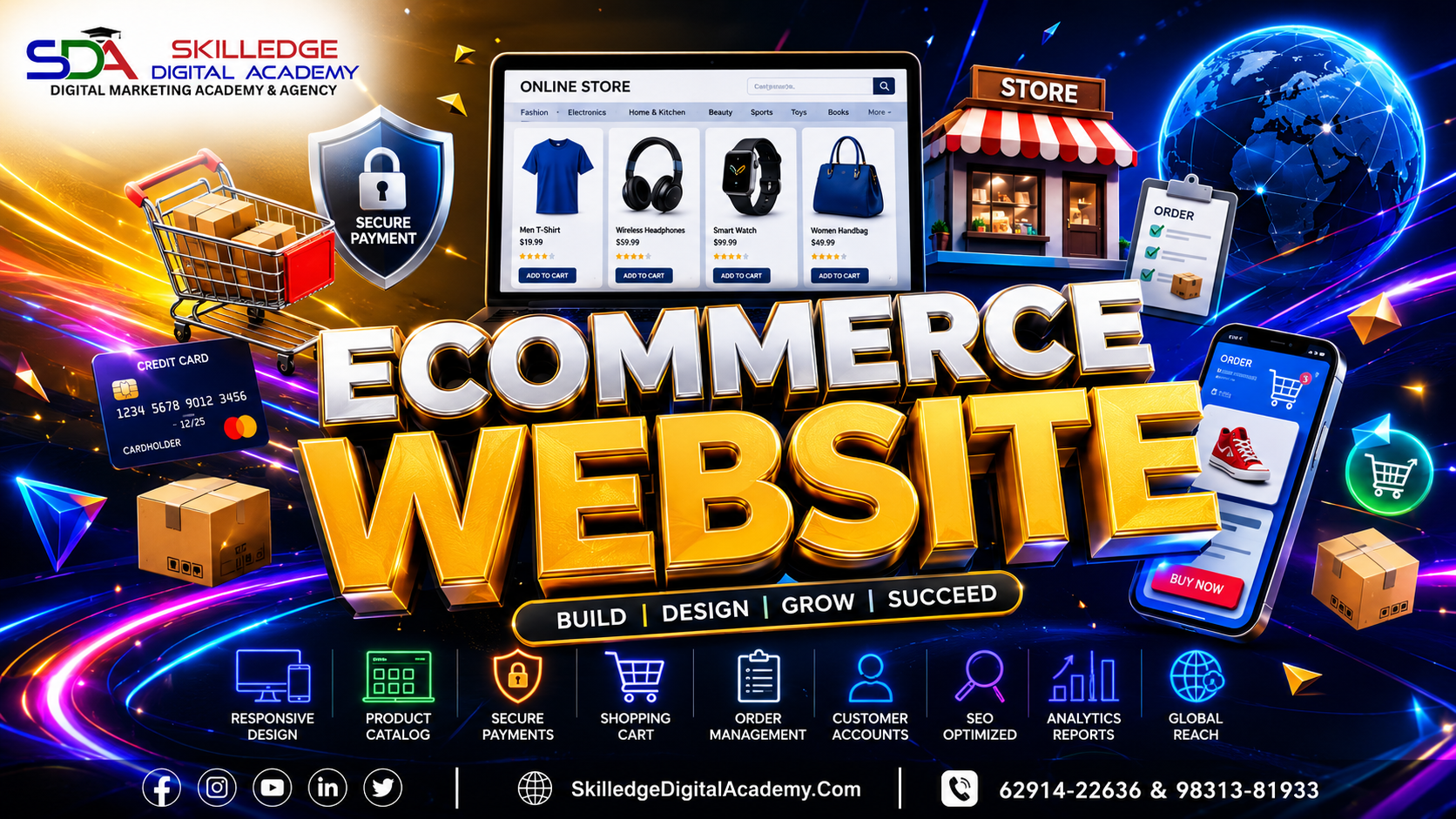
What is an Ecommerce Website? The 2026 Blueprint for High-Converting Stores:What is an Ecommerce Website Beyond “Pages + Cart”
Students often ask, “What is an ecommerce website?” They picture product pages, a cart, and checkout. But in 2026, what is an ecommerce website is a conversion engine with these non-negotiable layers:
Performance: <1.5s load time on mobile (Google’s Core Web Vitals)
UX: One-click checkout, guest checkout, auto-fill addresses
Personalization: AI recommendations (“Customers who bought X also bought Y”)
Trust: SSL, visible return policy, reviews, trust badges
SEO: Technical + content SEO for product + category pages
Analytics: GA4, heatmaps, funnel tracking
Concrete data: Stores with <1.5s load time convert 2.5× better than those with 3s+.
What is an Ecommerce Website Must-Haves (Checklist for 2026)
When you build what is an ecommerce website, don’t skip these:
Product catalog with variants (size, color, material)
Search with autosuggest (e.g., “red dress” → shows red dresses)
Shopping cart with persistent state (even if user leaves)
Secure checkout (PCI-DSS, 3D Secure)
Multiple payment options: UPI, Cards, Wallets, BNPL
Order tracking + self-service returns
Mobile-first design (60%+ traffic is mobile in India)
At Skilledge Digital Academy, you’ll build a live what is an ecommerce website in class—connecting Razorpay, setting up UPI, and running your first checkout. No simulations. Real transactions.
What is an Ecommerce Platform? SaaS vs Open-Source vs Headless vs Composable: And Why Your Choice Determines Your Ceiling
When you ask, “What is an ecommerce platform?”, you’re really asking: “What software will host my store, manage inventory, process payments, and scale with me?”
In 2026, there are four architectures:
Key insight: What is an ecommerce platform isn’t just “Shopify vs WooCommerce.” It’s about architecture that matches your growth stage.
What is the Best Ecommerce Platform for Small Business in 2026?
You’re probably wondering: “What is the best ecommerce platform for small business?” Here’s the 2026 answer with pricing:
Winner for small business: Shopify or Square Online for speed and reliability.
Why Shopify? You get the fastest path from idea to first sale. That’s critical when you’re testing product-market fit. At Skilledge Digital Academy, we launch student stores on Shopify in Week 2—real store, real products, real checkout.
What is the Best Ecommerce Platform for Startups? Speed + Scale
When founders ask, “What is the best ecommerce platform for startups?”, they need two things:
Speed to first sale (validate fast)
Scalability (don’t migrate at ₹10Cr revenue)
Top picks for startups in 2026:
Shopify (best overall): Fast setup, 100k+ apps, global payments
BigCommerce (no transaction fees): Better for high-volume startups
Headless Shopify Plus (for tech-first startups): Custom frontend, same backend
Concrete example: A D2C snack startup in Pune used what is the best ecommerce platform for startups (Shopify) to launch in 10 days, run Instagram ads, hit ₹10L/month in 60 days, then migrated to headless at ₹5Cr revenue.
At Skilledge Digital Academy, we teach startup founders to pick what is the best ecommerce platform for startups based on revenue stage, not hype.
What is Ecommerce Marketing? The 2026 Playbook Beyond Ads (Why Beginners Get It Wrong)
Ecommerce marketing in 2026 goes far beyond “run ads.” It’s a full-funnel discipline combining audience-first product positioning, data-driven creative, and lifecycle systems that convert one-time buyers into repeat customers. Beginners often fixate on ad spend and clicks, ignoring fundamentals: clear value proposition, frictionless checkout, and post-purchase experience. Start by defining your ideal customer and the single promise your product delivers. Map the entire journey — awareness, consideration, purchase, retention — and assign a measurable tactic to each stage: organic content and partnerships for awareness, high-converting product pages and social proof for consideration, lean checkout flows and targeted promos for purchase, and email/sms flows plus loyalty offers for retention.
In 2026, creative and data must work together: test multiple creatives fast, use short-form video and UGC, and tie creative variants to cohort-level LTV and ROAS, not just CTR. Automate lifecycle messaging, use predictive segments to boost repeat rate, and invest in owned channels to lower dependency on paid. Finally, measure unit economics (CAC vs. LTV) and optimize for profitability, not vanity metrics. When marketers treat ecommerce as an end-to-end system rather than a channel, growth becomes sustainable and scalable.
What is Ecommerce Marketing Must-Haves (2026 Checklist)
When you build what is ecommerce marketing, include these:
SEO for product pages: Keyword优化的 title tags, meta descriptions, schema markup
Email flows: Welcome, abandoned cart, post-purchase, win-back (40% of revenue)
SMS marketing: 98% open rate, used for flash sales, COD confirmations
Retargeting: Pixel-based ads for cart abandoners
Influencer collabs: Micro-influencers (10k–100k followers) for trust
Reviews + UGC: Social proof boosts conversion by 270%
Loyalty program: Repeat customers spend 3× more
Concrete campaign: A Kolkata fashion brand used what is ecommerce marketing to run:
Instagram Reels + influencer unboxing → 50k views
Abandoned cart email + SMS → 22% recovery
Loyalty points for reviews → 1,200 UGC photos
Result: ₹18L revenue in 30 days, CAC ₹180, LTV ₹2,400.
At Skilledge Digital Academy, you’ll run what is ecommerce marketing campaigns live—setting up Klaviyo flows, running Meta ads, measuring ROAS. You’ll graduate with a portfolio, not just a certificate.
What is Ecommerce in 2026? 8 Trends That Redefine “Online Shopping”: AI Personalization, Headless Commerce, and Retail Media Networks
When you ask, “What is ecommerce in 2026?”, you need to know the trends reshaping the industry. Here are the 8 that matter:
Generative AI for product descriptions, images, and personalization
Tools: Shopify Magic, Midjourney, Copy.ai
Impact: 30% faster content creation, 20% higher conversion
Headless & Composable Commerce
Frontend (React/Next.js) Decoupled from backend (Shopify, BigCommerce)
Benefit: Custom UX, omnichannel (web, app, voice, AR)
Retail Media Networks
Brands advertise on Amazon, Flipkart, Walmart (like Google Ads but on marketplaces)
2026 spend: $50B+ globally
Voice & Visual Search
“Hey Google, buy red sneakers” → Direct to checkout
Pinterest Lens, Google Lens for image-to-product
Sustainability-Driven Logistics
Carbon-neutral shipping, eco-packaging, return-once policies
68% of Gen Z pays more for sustainable brands
Social Commerce
Instagram Shops, WhatsApp Catalog, YouTube Shopping
42% of Gen Z discovers products on social
BNPL (Buy Now, Pay Later)
Simpl, LazyPay, Klarna—increases AOV by 35%
AR/VR Try-On
Virtual try-on for glasses, makeup, furniture
Reduces returns by 25%
Why this matters for you: If you build what is ecommerce without these trends, you’ll launch a 2020 store in 2026. At Skilledge Digital Academy, we teach 2026 trends live—AI tools, headless demos, retail media setup.
What is Ecommerce Business Metrics That Actually Matter (And How to Track Them)
When you ask, “What is ecommerce business success?”, the answer is metrics. Here are the 7 that matter:
Concrete example: A D2C brand had CAC ₹300, LTV ₹900 (ratio 3:1). They optimized email flows, increased LTV to ₹1,800 (ratio 6:1), and scaled ads 5×.
At Skilledge Digital Academy, you’ll track what is ecommerce metrics on your live store—GA4, Meta Pixel, Klaviyo dashboards. You’ll learn to pivot based on data, not gut.
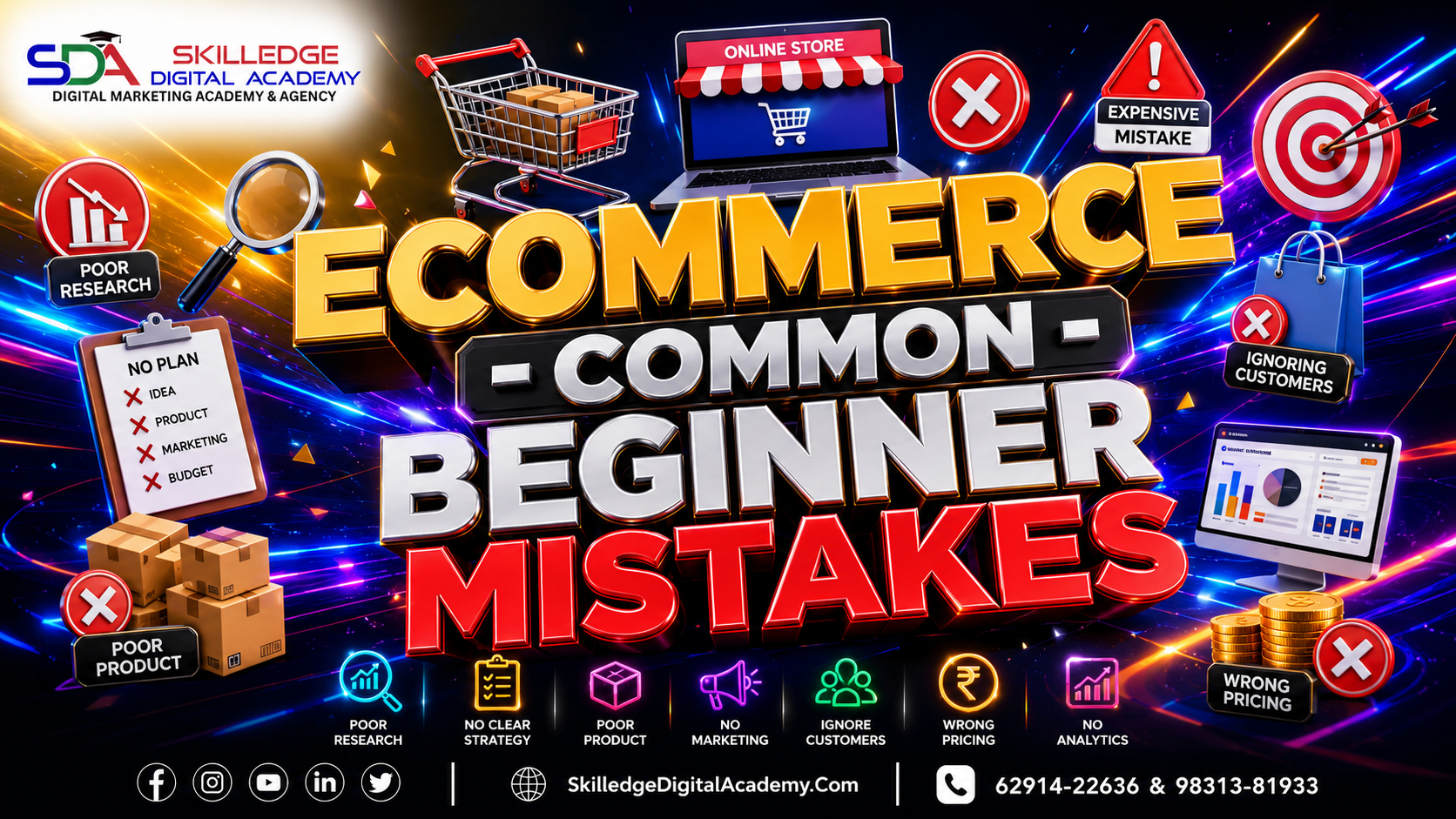
What is Ecommerce—Common Beginner Mistakes (And How to Avoid Them)
When you learn what is ecommerce, avoid these 7 mistakes:
Picking the wrong platform: Choosing what is the best ecommerce platform for small business based on price, not scale.
Ignoring mobile UX: 60%+ traffic is mobile; slow mobile = lost sales.
No email/SMS flows: 40% of revenue comes from automated flows.
Poor product photos: Blurry images = no trust.
No reviews: Stores without reviews convert 50% less.
Overloading on ads: Burning cash on Facebook before validating product.
Ignoring SEO: 40% of traffic should be organic.
Fix: At Skilledge Digital Academy, we audit your what is ecommerce store live—load time, UX, flows, SEO. You’ll leave with a plan, not just theory.
What is Ecommerce: Your 90-Day Launch-to-₹10L/Month Blueprint
Ecommerce is more than an online storefront — it’s a repeatable system that turns ideas into consistent revenue. This 90-day launch-to-scale blueprint breaks the process into clear, actionable phases so you move from concept to a sustainable ₹10L/month business. Start with rapid validation: pick one niche, research customer pain points, and test product-market fit using low-cost ads or social posts. Week 2–4 focus on creating a conversion-ready offering — finalize a winning product, craft compelling copy, and build a simple, mobile-first store with reliable payment and shipping options. In month two, scale customer acquisition: optimize ads, expand to high-converting channels (email, organic social, influencers), and implement retargeting to recover lost sales. Parallel to growth, tighten operations: streamline order fulfilment, automate customer support templates, and set up basic inventory and cashflow tracking. Month three centers on optimization and retention: use A/B tests, analytics, and customer feedback to boost average order value and repeat purchase rates. Introduce subscription or bundling strategies and a referral program to compound growth. With focused execution, measurable KPIs, and iterative learning, the 90-day plan moves you from idea to a scalable ecommerce engine capable of reaching ₹10L/month.
What is Ecommerce — Why Skilledge Digital Academy Is Your Best Mentor
Ecommerce, or electronic commerce, is the process of buying and selling products or services online through websites, marketplaces, mobile apps, and social media platforms. From global brands to small businesses, ecommerce has transformed how companies reach customers, manage sales, and scale their operations. As the industry continues to grow, businesses are actively seeking professionals who understand online store management, digital marketing, marketplace operations, analytics, and customer experience.
This is where Skilledge Digital Academy stands apart. We teach ecommerce the way employers expect it to be learned—through practical, industry-focused training that develops real-world skills. Our comprehensive ecommerce program covers product research, Amazon and Flipkart marketplace management, Shopify store development, UI/UX fundamentals, inventory and logistics management, SEO, PPC advertising, social media marketing, analytics, and customer relationship management.
Rather than relying on theory alone, students gain hands-on experience by working on live ecommerce projects. You’ll learn how to build and launch an online store, optimize product listings for higher conversions, create and manage advertising campaigns, and analyze performance data to improve business results. Every project is designed to help you develop a portfolio that demonstrates your capabilities to potential employers.
Our industry mentors provide personalized guidance, portfolio reviews, resume optimization, and mock interview preparation to help students become job-ready. In addition, we offer career support services, internship opportunities, placement assistance, and guidance for freelance and ecommerce entrepreneurship pathways.
Whether you’re a student, working professional, entrepreneur, or career changer, Skilledge Digital Academy bridges the gap between learning and employment. Through practical training, expert mentorship, and career-focused support, we help transform ecommerce knowledge into valuable, market-ready skills that employers recognize and trust.
What is Ecommerce—FAQs (Answering Your Top Questions)
Q: What is Ecommerce Business for Beginners?
A: What is ecommerce business for beginners is starting with a D2C or B2C model on what is the best ecommerce platform for small business (Shopify), selling 5–10 products, and validating demand with ₹5k ad spend. At Skilledge Digital Academy, we guide you through this in Week 1–4.
Q: What is the best ecommerce platform for startups?
A: What is the best ecommerce platform for startups is Shopify for speed + scale. If you’re tech-first, consider headless Shopify Plus. At Skilledge Digital Academy, we help you pick based on your stage.
Q:What is an Ecommerce Website Checklist?
A: What is an ecommerce website needs: fast load time (<1.5s), mobile-first design, secure checkout, UPI/payments, reviews, email flows, GA4 tracking. We build this live at Skilledge Digital Academy.
Q: What is ecommerce marketing for my first ₹10L?
A: What is ecommerce marketing for ₹10L includes: Meta ads (₹20k/month), email flows (abandoned cart, welcome), Instagram influencers (5–10 micro), SEO for 10 product pages. At Skilledge Digital Academy, you run all four.
Q: What is an ecommerce platform for ₹50k/month revenue?
A: What is an ecommerce platform for ₹50k/month is Shopify (₹2k/month) or WooCommerce (₹500/month hosting). At Skilledge Digital Academy, we match platform to revenue.
Q: E Commerce What Is It in Simple Terms?
A: E commerce what is it in simple terms: selling products/services online via a website/app, with payment + delivery. But in 2026, e commerce what is it also includes AI, headless, retail media, and subscriptions. At Skilledge Digital Academy, we teach the full 2026 picture.

Final Call to Action: Launch Your Ecommerce Career at Skilledge Digital Academy
You now know what is ecommerce, what is ecommerce business, what is the best ecommerce platform for small business, what is the best ecommerce platform for startups, what is an ecommerce website, what is an ecommerce platform, what is ecommerce marketing, and e commerce what is it in 2026.
But knowing isn’t enough. You need to do.
Skilledge Digital Academy

Key Features at a Glance
| Feature | Details | Available |
|---|---|---|
| Free Demo Class | Experience a live session before committing | ✓ Yes |
| Live Online Training | Real-time classes with mentor interaction | ✓ Yes |
| 5+ Certifications | Google, Meta, HubSpot, SEMrush & more | ✓ Yes |
| 100% Placement Assistance | Resume review, mock interviews, referrals | ✓ Yes |
| Round the Clock Support | Mentor available 24/7 via WhatsApp & chat | ✓ Yes |
| Interview Preparation | Dedicated sessions + real interview simulations | ✓ Yes |
Training Modules Covered
Our curriculum is built for the 2026 industry:
| Module | What You’ll Master |
| SEO (Search Engine Optimization) | On-page, off-page, technical SEO & keyword strategy |
| SEM (Search Engine Marketing) | Paid search strategy, bidding, Quality Score optimization |
| SMO (Social Media Optimization) | Profile growth, organic reach, platform algorithms |
| SMM (Social Media Marketing) | Campaign strategy, content calendars, community building |
| Facebook & Instagram Ads | Meta Ads Manager, audience targeting, creative testing |
| Google Ads | Search, Display, Shopping, Performance Max campaigns |
| Website Development | WordPress, landing page design, CRO fundamentals |
| Graphic Designing | Canva, Adobe tools, social media creative design |
| Affiliate Marketing | Platforms, commission models, traffic monetization |
| Content Marketing | Blog strategy, copywriting, email marketing, funnels |
| AI Softwares & Tools | ChatGPT, Jasper, Midjourney, automation for marketers |
Enroll in our 3 month live online Digital Marketing training today! Enjoy 90% practical sessions, round-the-clock support, and 100% placement assistance.
Skilledge Digital Academy
📞 Phone/WhatsApp: +91 62914-22636 / +98313-81933
📧 Email: edu@skilledgedigitalacademy.com
🌐 Website: www.skilledgedigitalacademy.com