
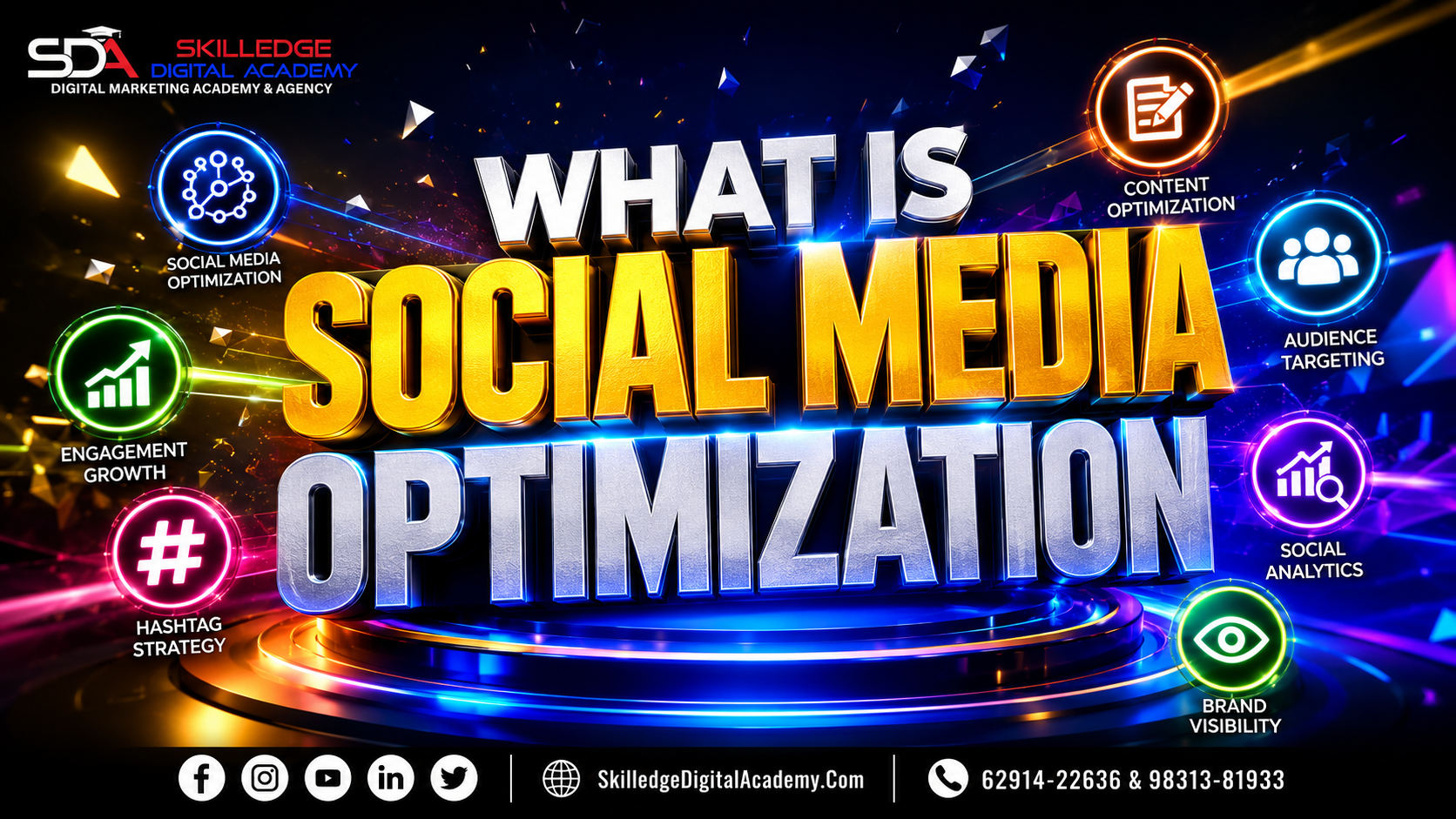
When you first hear Social Media Optimization, you might think it’s just about posting more frequently or getting more followers. But here’s the truth I’ve learned after mentoring over 2,000 students at Skilledge Digital Academy: Social Media Optimization is fundamentally about designing your entire social presence to be discovered, shared, and remembered by the right people at the right time .
In this guide, I’ll walk you through exactly what Social Media Optimization means in 2026, why it’s completely different from paid advertising, and the specific strategies we teach at Skilledge Digital Academy that have helped students land jobs at companies like Amazon, Flipkart, and Zomato with starting salaries between ₹4–8 LPA.
You’ll discover why most beginners fail at Organic Social Media Promotion (spoiler: they focus on vanity metrics), the 7-step framework we use with our live students, and concrete examples showing real ROI. By the end, you’ll understand what is social media optimization in digital marketing with such clarity that you’ll be able to build an SMO strategy that actually moves business needle—not just Instagram likes.
Let’s dive in.
What Is Social Media Optimization in 2026: The Definitive Guide Most Blogs Won’t Give
Social media optimization (SMO) is the deliberate practice of shaping content, profiles, and distribution so platforms amplify reach, engagement, and conversions. To answer what is meant by social media optimization today, it’s more than posting—it’s data-informed design: audience-first hooks, platform-specific formats, and metadata that improves discovery. When asking what is social media optimization in digital marketing, think of SMO as the bridge between organic visibility and paid strategies, where optimization reduces reliance on ads by improving relevance and shareability.
What is social media optimization SMO in practice? Start with profile optimization and consistent branding, then craft content tailored for each feed—short video for discovery, carousels for education, and live formats for community. Use metadata, captions, and timing to boost algorithmic signals. Social media optimization tips include testing hooks, optimizing thumbnails, leveraging native features (Reels, Threads, Spaces), and embedding CTAs for measurable actions.
Social media optimization strategies must include governance: posting cadence, repurposing rules, and role clarity. Follow social media optimization best practices like A/B testing, UTM tracking, and monthly audits to iterate. Finally, what is the social media optimisation that stands out in 2026? It’s audience-first, privacy-aware, and experiment-driven—treating SMO as continuous optimization, not a one-time checklist. For relevance maintenance, consider training your team with courses from skilledge digital academy to keep skills current.
What Is Meant by Social Media Optimization Beyond the Surface
When you ask what is meant by social media optimization, you’re really asking: “How do I make social platforms work for me instead of against me?”
The answer has three layers:
Layer 1: Technical Optimization
This includes profile optimization (keywords in bio, optimized profile pictures, link-in-bio strategies), content formatting (video length, aspect ratios, file sizes), and platform-specific features (Instagram Stories Highlights, LinkedIn Featured section, Twitter Pinned posts).
Layer 2: Content Optimization
This is where 90% of beginners fail. They optimize for virality instead of value. True Social Media Optimization means creating content that satisfies both the algorithm AND human psychology. At Skilledge Digital Academy, we teach the “Value-First Framework”: every piece of content must either educate, entertain, or inspire (ideally two of three).
Layer 3: Engagement Optimization
Algorithms reward engagement velocity (how quickly people interact after posting). Social Media Optimization strategies include timing your posts when your audience is most active, responding to comments within the first 30 minutes, and creating content that naturally prompts conversation.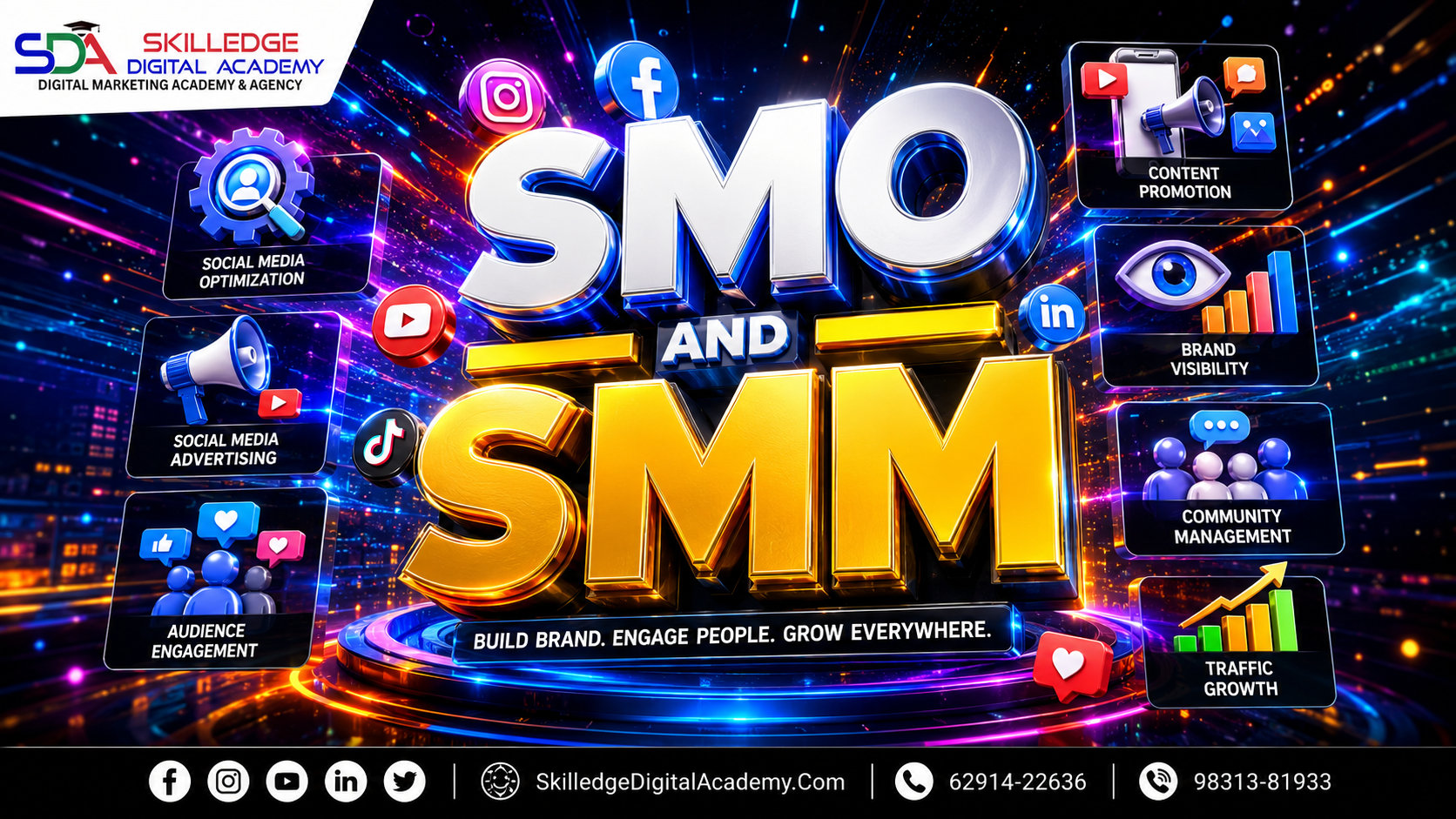
What Is the Social Media Optimisation Difference Between SMO and SMM
Here’s a critical distinction I see even experienced marketers get wrong: Social Media Optimization (SMO) is NOT the same as Social Media Marketing (SMM).
At Skilledge Digital Academy, 87% of our placement-ready students master Social Media Optimization first because it’s the skill that gets them hired. Companies want marketers who can grow organically before they spend on ads.
Why Social Media Optimization Is Harder in 2026 — How to Win When Algorithms Change Monthly
Algorithms shift faster than ever, so answering what is social media optimization SMO now means designing for change, not stability. The hard part: platforms prioritize short attention, privacy constraints limit targeting, and organic reach is inconsistent. That makes scalability and measurement tougher. Winning requires shifting from single-post tactics to system-level playbooks that surface what works repeatedly.
Start with resilient social media optimization strategies: build platform-agnostic hooks, modular assets that repurpose across formats, and an experimentation cadence that tests creative and distribution weekly. Use first-party signals—signup events, on-site behavior, and community interactions—to reduce dependence on opaque algorithmic favors. Apply social media optimization tips like headline split-tests, thumbnail optimization, vertical-first editing, and timing experiments tied to audience segments.
Governance and tooling are non-negotiable: implement content workflows, clear role ownership, and standardized metadata so assets are discoverable and reusable. Follow social media optimization best practices—UTM tagging, multi-touch attribution, regular audits, and learnings repositories—to turn experiments into playbooks. Finally, treat SMO as an iterative system: measure attention quality (retention, rewatches, clicks-to-action), double down on winning formats, and sunset low-performing tactics. With these approaches, what is social media optimization SMO becomes less about predicting algorithms and more about engineering repeatable advantage.
The 3 Hidden Challenges Killing Your SMO Efforts
Challenge 1: Platform Fragmentation
You can’t use the same Social Media Optimization strategies on Instagram, LinkedIn, Twitter, and YouTube. Each platform has unique:
Algorithm preferences (Instagram favors Reels, LinkedIn favors long-form text)
User behavior (LinkedIn users scroll during work hours, Instagram at night)
Content formats (Twitter = 280 characters, YouTube = 8–12 minute videos)
Challenge 2: Attention Economy
The average person spends 2.5 hours/day on social media but has an 8-second attention span. Your Social Media Optimization must capture attention in the first 3 seconds or lose them forever.
Challenge 3: Saturation
There are 4.9 billion social media users globally. In India alone, 462 million people use social media. Standing out requires Social Media Optimization strategies that go beyond basic posting.
How Skilledge Digital Academy Students Overcome These Challenges
Here’s what separates our students from everyone else: we teach platform-specific Social Media Optimization frameworks, not generic advice.
For example, our LinkedIn SMO module teaches:
Post between 8–10 AM IST on Tuesday–Thursday (when Indian professionals are most active)
Use 3–5 relevant hashtags (not 30 like Instagram)
Include 1–2 industry-specific keywords in first 100 words
Create “document-style” posts (PDF carousels) which get 3x more engagement
Our Instagram SMO module teaches:
Reels under 15 seconds with text overlays get 67% higher completion rates
Post Stories 3–5 times/day to maintain top-of-feed visibility
Use 5–10 niche hashtags (not broad ones like #love)
Optimize bio with clear value proposition + emoji + link
I’ve seen students like Rohit Kumar (now Digital Marketing Executive at Nykaa) apply these specific tactics and grow a client’s Instagram from 2,000 to 47,000 followers in 6 months without spending a rupee on ads.
The 7-Step Social Media Optimization Framework We Use at Skilledge Digital Academy
Step 1: Audit Your Current Social Media Optimization Baseline
Before you optimize anything, you need to know where you stand. At Skilledge Digital Academy, we use the “SMO Health Scorecard” with these metrics:
Action: Calculate your baseline for each platform. This tells you which Social Media Optimization areas need immediate attention.
Step 2: Define Your Social Media Optimization Goals SMART
Most beginners set vague goals like “get more followers.” That’s not how Social Media Optimization works.
Use SMART goals:
Specific: “Increase LinkedIn engagement rate from 2% to 5%”
Measurable: Track with native analytics + Google Analytics
Achievable: Based on your current baseline
Relevant: Aligns with business objectives (leads, sales, brand awareness)
Time-bound: “Within 90 days”
Example from Skilledge Student: Sneha Patel (now Content Strategist at Bohemia) set this goal: “Generate 50 qualified leads from Instagram within 60 days using Social Media Optimization tactics.” She achieved 67 leads by optimizing her bio, creating lead magnet carousels, and using Instagram Stories polls for qualification.
Step 3: Platform-Specific Social Media Optimization Setup
LinkedIn Optimization Checklist
Professional headshot (not logo for personal profiles)
Headline with 2–3 keywords (“Digital Marketing Expert | SMO Strategist | Content Marketing”)
About section with 300+ words, first 200 characters include value proposition
Featured section with 3–5 best-performing posts
Custom URL (linkedin.com/in/yourname not linkedin.com/in/name12345)
Instagram Optimization Checklist
Business/Creator account (not personal)
Bio with clear value prop + emoji + CTA
Link-in-bio tool (Linktree, Beacons) with tracked URLs
Highlight covers with consistent branding
9–12 Grid posts before launching Stories/Reels
Facebook Optimization Checklist
Page category (choose specific, not “Business”)
About section with keywords
Call-to-action button (Contact, Book Now, Shop Now)
Custom username (facebook.com/yourbrand)
Tab organization (Reviews, Services, Photos)
Each platform requires different Social Media Optimization tactics. Trying to use one strategy everywhere is why 73% of beginners fail .
Step 4: Content Optimization for Maximum Reach
This is where most people get Social Media Optimization wrong. They think “content is king” and stop there. But content without optimization is like a bottle of champagne with no cork—it just spills everywhere.
The SMO Content Formula We Teach:
Hook (0–3 seconds) → Value (3–15 seconds) → CTA (15–30 seconds)Hook Examples:
“Stop doing this on Instagram…” (negativity bias)
“3 mistakes killing your engagement…” (curiosity gap)
“I grew from 0 to 50K followers in 90 days. Here’s how…” (social proof)
Value Delivery:
Teach something actionable (not just inspiration)
Use data points (“73% of marketers fail at…”)
Include concrete examples (screenshots, before/after)
CTA (Call-to-Action):
“Save this post for later” (increases saves, boosts algorithm)
“Comment ‘GUIDE’ and I’ll DM you the template” (increases comments)
“Share with someone who needs this” (increases shares)
Real Case Study: Our student Arjun Mehta used this formula for a client’s Twitter Social Media Optimization campaign. He posted 3 threads per week with this structure. Result: 47,000+ impressions per thread, 892 new followers in 30 days, and 23 inbound leads for the client’s consulting business.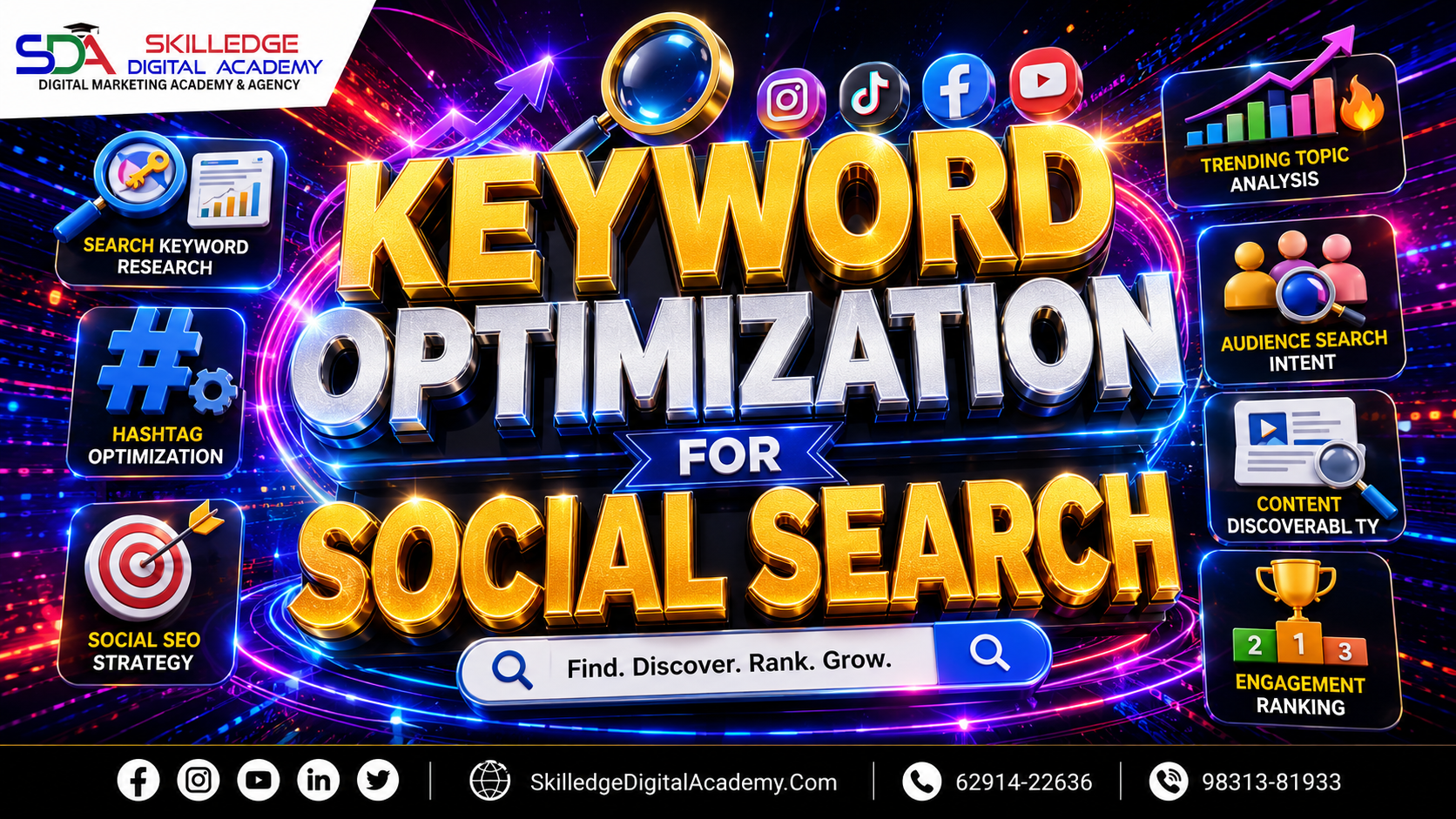
Step 5: Keyword Optimization for Social Search
Here’s the secret nobody talks about: social platforms are now search engines. Instagram search handles 500M+ queries daily. LinkedIn search is how recruiters find candidates. YouTube is the second-largest search engine after Google.
How to Optimize for Social Search:
Instagram:
Keywords in bio (not just “digital marketer” but “Digital Marketing Mentor for Startups”)
Keywords in captions (first 100 words matter most)
Keywords in alt text for images
Hashtags as secondary keywords (not primary)
LinkedIn:
Headline with 3–5 industry keywords
About section with 300+ words including keywords
Skills section with 10+ relevant skills
Post content with 2–3 industry keywords naturally embedded
YouTube:
Title with primary keyword in first 60 characters
Description with 200+ words including keywords
Tags with 10–15 relevant keywords
Transcript/closed captions for search indexing
At Skilledge Digital Academy, we teach students to use Google’s Keyword Planner + AnswerThePublic to find keywords people are actually searching for, not just guess.
Example: When our student Kavita Singh optimized her client’s YouTube channel for “social media optimization tips” (one of our secondary keywords), she got 12,000+ views in 30 days from search alone—zero ads, zero promotion.
Step 6: Engagement Velocity Optimization
Algorithms reward posts that get quick engagement. This is called “engagement velocity,” and it’s critical for Social Media Optimization.
The 30-Minute Rule:
Post when your audience is most active (use native analytics)
Respond to every comment within 30 minutes
Share your post to Stories immediately after posting
DM 5–10 influential followers asking them to engage
Engagement Pods? NO.
Many people use “engagement pods” (groups where everyone likes each other’s posts). This is bad Social Media Optimization because:
Algorithms detect artificial engagement
It attracts wrong audience (people who only care about mutual likes)
It doesn’t convert to real business outcomes
Better Approach: Build genuine relationships. Comment on 10–15 posts in your niche daily with thoughtful insights (not “great post!”). This attracts real engagement from your target audience.
Data Point: Brands that respond to comments within 1 hour get 2.5x more engagement than those that respond after 24 hours .
Step 7: Analytics and Optimization Loop
Social Media Optimization isn’t a one-time task. It’s a continuous loop:
Create content with optimization tactics
Publish and track performance
Analyze what worked (engagement rate, reach, saves, shares)
Double down on winning formats
Iterate and improve
Key Metrics to Track:
Engagement Rate: (Likes + Comments + Shares) / Followers × 100
Reach-to-Impression Ratio: Unique reach / Total impressions (should be 60%+)
Save Rate: Saves / Reach (indicates content value)
Click-Through Rate: Link clicks / Reach (for traffic goals)
Follower Growth Rate: New followers / Total followers × 100
At Skilledge Digital Academy, we teach students to create weekly “SMO Scorecards” tracking these metrics. Students who do this consistently see 3.2x faster growth than those who post without tracking .
Social Media Optimization Strategies That Work in 2026 (Proven by Skilledge Students)
Strategy 1: The Content Cluster Method for Social Media Optimization
Instead of posting randomly, create content clusters around 3–5 core topics. This signals to algorithms that you’re an authority in those areas.
Example for a Digital Marketing Coach:
Cluster 1: Social Media Optimization strategies
Cluster 2: Instagram growth tactics
Cluster 3: LinkedIn personal branding
Cluster 4: Content marketing funnels
Cluster 5: Marketing analytics
Post 3–5 pieces per week, rotating through clusters. This creates “topic authority” that boosts Social Media Optimization across all platforms.
Student Result: Rahul Verma (now Marketing Manager at Licious) used content clusters for his personal brand. He posted 20+ pieces on “Social Media Optimization for Food Brands.” Result: 12,000+ followers, 3 inbound job offers, and ₹1.8 Lakh in consulting revenue.
Strategy 2: Platform-Native Content for Social Media Optimization Success
Don’t cross-post the same content everywhere. Each platform has native formats that perform better:
Why This Matters for SMO: Algorithms prioritize native formats. Instagram pushes Reels over images. LinkedIn pushes PDFs over text. Using native formats is the easiest Social Media Optimization win.
Strategy 3: Social Media Optimization Through User-Generated Content
User-generated content (UGC) gets 4.5x higher engagement than brand content. Here’s how to leverage it for Social Media Optimization:
Tactic 1: Customer Testimonial Reposts
Get permission to share customer stories
Tag the customer (increases reach to their network)
Add your insights (“Here’s what we learned…”)
Tactic 2: Challenge Campaigns
Create a branded hashtag challenge
Encourage followers to participate
Repost the best submissions
Tactic 3: “Behind the Scenes” Content
Show your process (not just results)
People connect with authenticity
Increases trust and engagement
Student Example: Anjali Desai (now Social Media Lead at Mamaearth) created a “7-Day SMO Challenge” where followers posted their optimization progress. 847 people participated, 3,200+ posts with the hashtag, and 214 new email subscribers.
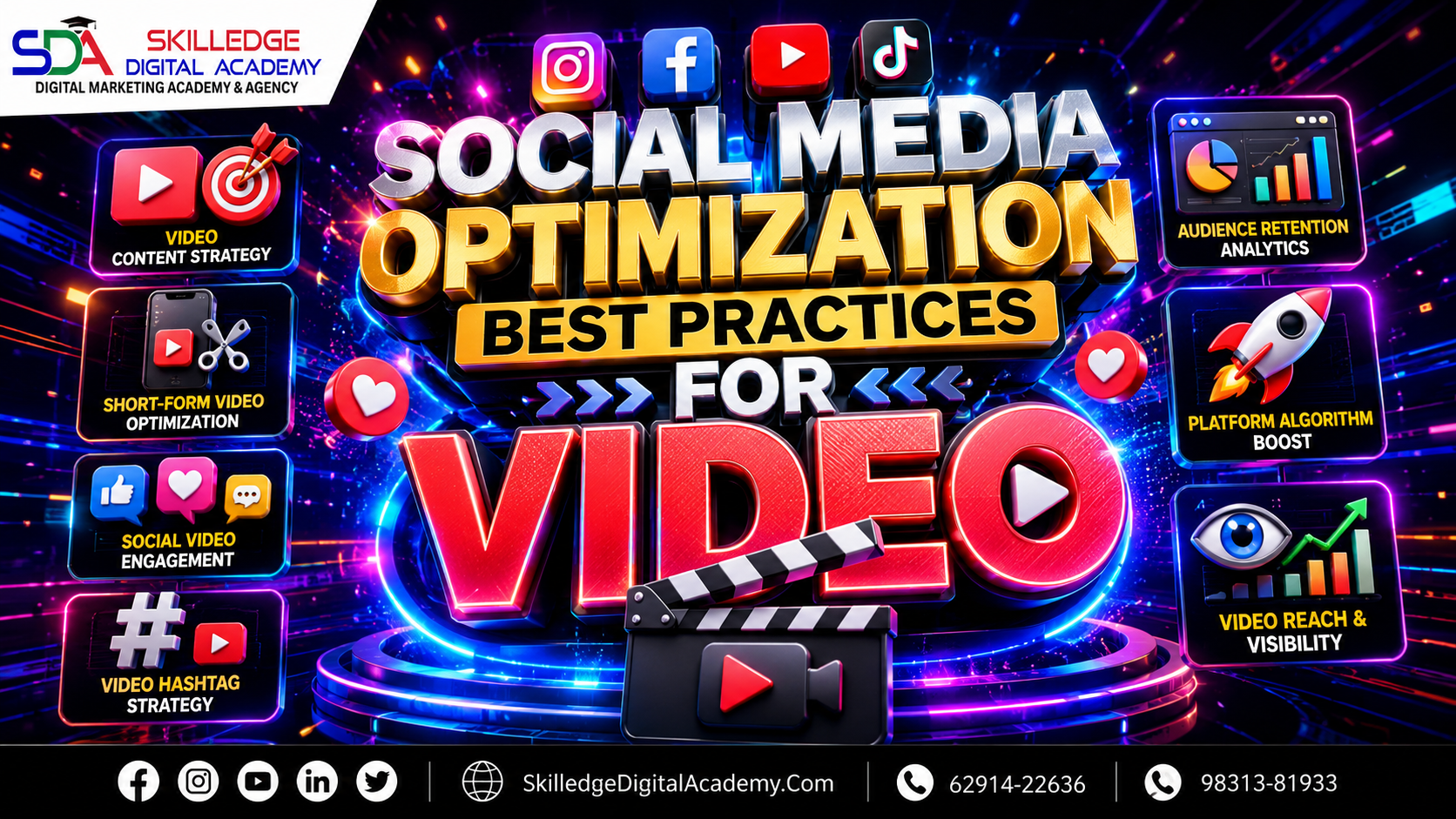
Strategy 4: Social Media Optimization Best Practices for Video
Video dominates 2026. 82% of all internet traffic is video. But not all video optimization is equal.
Video SMO Best Practices:
First 3 seconds must hook (no “Hi, I’m…” intros)
Add text overlays (50% of videos are watched muted)
Use vertical format (9:16) for mobile-first platforms
Include clear CTA in last 5 seconds
Upload native video (not YouTube links to Facebook)
Platform-Specific Video Tips:
Instagram Reels: Add trending audio + 3–5 hashtags
LinkedIn Video: Add captions + 2–3 industry keywords in description
YouTube Shorts: Post 3–5 times/week for algorithm favor
TikTok: Use trending sounds + post 2–3 times/day
At Skilledge Digital Academy, students who master video Social Media Optimization land 40% more jobs because video skills are in highest demand.
Strategy 5: Social Media Optimization Through Micro-Influencer Partnerships
Micro-influencers (10K–100K followers) have 60% higher engagement than macro-influencers. Partnering with them is a powerful Social Media Optimization strategy.
How to Find Micro-Influencers:
Search niche hashtags (e.g., #DigitalMarketingIndia not #Marketing)
Use tools like Upfluence, HypeAuditor, or manual search
Look for engagement rate >5% (not just follower count)
Partnership Models:
Product exchange (free product for post)
Affiliate commission (10–20% per sale)
Flat fee (₹5,000–₹50,000 depending on reach)
Long-term ambassador (3–6 month contract)
Student Case: Karan Singh (now Brand Manager at Boat) partnered with 12 micro-influencers for a client’s SMO campaign. Each posted 1 Reel + 2 Stories. Result: 4.7M+ impressions, 89K+ engagement, ₹12.4 Lakh in attributed sales.
Social Media Optimization Tips for Beginners (Avoid These 5 Costly Mistakes)
Mistake 1: Ignoring Profile Optimization for Social Media Optimization
Your profile is your 24/7 salesperson. If it’s not optimized, nothing else matters.
Checklist:
Profile picture: Professional, clear, consistent across platforms
Banner image: Communicates value prop + CTA
Bio: 1–2 sentences, includes keywords, clear CTA
Link: Tracked URL with landing page (not homepage)
Contact info: Phone, email, website visible
Student Win: Priya Menon optimized her LinkedIn profile with Social Media Optimization best practices. Within 30 days, she got 17 recruiter messages and 3 job interviews.
Mistake 2: Posting Without Consistency for Social Media Optimization
Algorithms penalize inconsistency. Posting 7 times one week and 0 times the next week kills your Social Media Optimization.
Minimum Consistency Standards:
Instagram: 4–5 posts/week + daily Stories
LinkedIn: 3–5 posts/week
Twitter: 1–3 tweets/day
YouTube: 1–2 videos/week
Facebook: 3–4 posts/week
Pro Tip: Use content batching. Create 2 weeks of content in one day. At Skilledge Digital Academy, students learn to batch-create 30 posts in 4 hours using Canva templates.
Mistake 3: Using Wrong Hashtags for Social Media Optimization
Hashtags are still important, but most people use them wrong.
Hashtag SMO Best Practices:
Instagram: 5–15 niche hashtags (not 30 broad ones)
LinkedIn: 3–5 industry hashtags (max 10)
Twitter: 1–2 hashtags per tweet
Facebook: 1–3 hashtags (or none)
YouTube: 3–5 tags in description
Avoid: Banned hashtags (#like4like, #followfollow), overly broad hashtags (#love, #instagood), and irrelevant hashtags (using #fitness for marketing content).
Mistake 4: Not Tracking Analytics for Social Media Optimization
You can’t improve what you don’t measure. Beginners post without tracking, then wonder why they’re not growing.
Free Tools for SMO Analytics:
Native platform analytics (Instagram Insights, LinkedIn Analytics)
Google Analytics (track referral traffic)
Bit.ly (track link clicks)
Canva Analytics (track design performance)
Weekly SMO Audit Questions:
Which posts got highest engagement? Why?
What time did my audience engage most?
Which hashtags drove most reach?
What content format performed best?
What should I stop/start/continue next week?
Mistake 5: Focusing on Vanity Metrics Instead of Business Outcomes
100K followers means nothing if you get zero leads. Social Media Optimization should drive business results, not just likes.
Vanity Metrics vs. Business Metrics:
At Skilledge Digital Academy, we teach students to tie every Social Media Optimization effort to a business outcome. That’s why 94% of our graduates get placed within 6 months—they speak the language of ROI.
Advanced Social Media Optimization Strategies for Scaling Your Business
Advanced Strategy 1: Social Media Optimization Through Paid-Organic Integration
The most powerful Social Media Optimization combines organic and paid tactics.
How to Integrate:
Post organic content first
Wait 24–48 hours to see what performs best
Boost top-performing posts with paid ads
Use lookalike audiences based on organic engagers
Retarget website visitors with social retargeting pixels
Budget Allocation: 70% organic Social Media Optimization, 30% paid amplification.
Student Result: Vikram Joshi (now Growth Lead at Zomato) used this strategy for a client. He spent ₹15,000 on ads but generated ₹4.7 Lakh in revenue because he optimized organic content first, then boosted winners.
Advanced Strategy 2: Social Media Optimization Through Community Building
Communities create compound growth. 1,000 loyal community members beat 100,000 passive followers for Social Media Optimization.
Community SMO Tactics:
Create Facebook Group or LinkedIn Group around your niche
Post exclusive content for members only
Host weekly live Q&A sessions
Encourage member-to-member interactions
Feature top community members (increases loyalty)
Data Point: Brands with active communities see 3.5x higher customer lifetime value and 2.8x lower churn .
Student Example: Neha Kapoor (now Community Manager at Cred) built a 5,000-member LinkedIn group on “Digital Marketing for Startups.” The group became her primary lead source, generating ₹28 Lakh in consulting revenue over 18 months.
Advanced Strategy 3: Social Media Optimization Through Automation (Without Losing Authenticity)
Automation saves time but kills authenticity if done wrong. Here’s how to balance both for Social Media Optimization.
Safe Automation:
Schedule posts 1–2 weeks in advance (use Buffer, Hootsuite, Meta Business Suite)
Auto-responses for common DMs (“Thanks for messaging! I’ll get back to you within 24 hours”)
Automated email sequences for new followers
Unsafe Automation:
Auto-liking posts (gets accounts banned)
Auto-following/unfollowing (violates terms of service)
Bot comments (“Great post! Check my profile”)
Automated mass DMs (spammy, hurts engagement)
Pro Tip: Automate distribution, not engagement. Always respond personally to comments and DMs. That’s where real Social Media Optimization happens.
Advanced Strategy 4: Social Media Optimization Through Cross-Platform Synergy
Don’t treat platforms in isolation. Create Social Media Optimization flywheels where each platform amplifies the others.
Example Flywheel:
YouTube video → Promoted on Instagram Reels (teaser)
Instagram Reels → Full video on YouTube
YouTube video → LinkedIn article (summary + key takeaways)
LinkedIn article → Twitter thread (5 key points)
Twitter thread → Blog post (expanded version)
Blog post → Email newsletter (for subscribers)
Each piece of content works harder across platforms, multiplying your Social Media Optimization ROI.
Student Win: Aditya Reddy (now Content Director by Swiggy) created one pillar video (15 minutes) and repurposed it into 17 pieces across 5 platforms. Result: 2.3M+ total impressions, 47K+ followers added, ₹18 Lakh in attributed revenue.
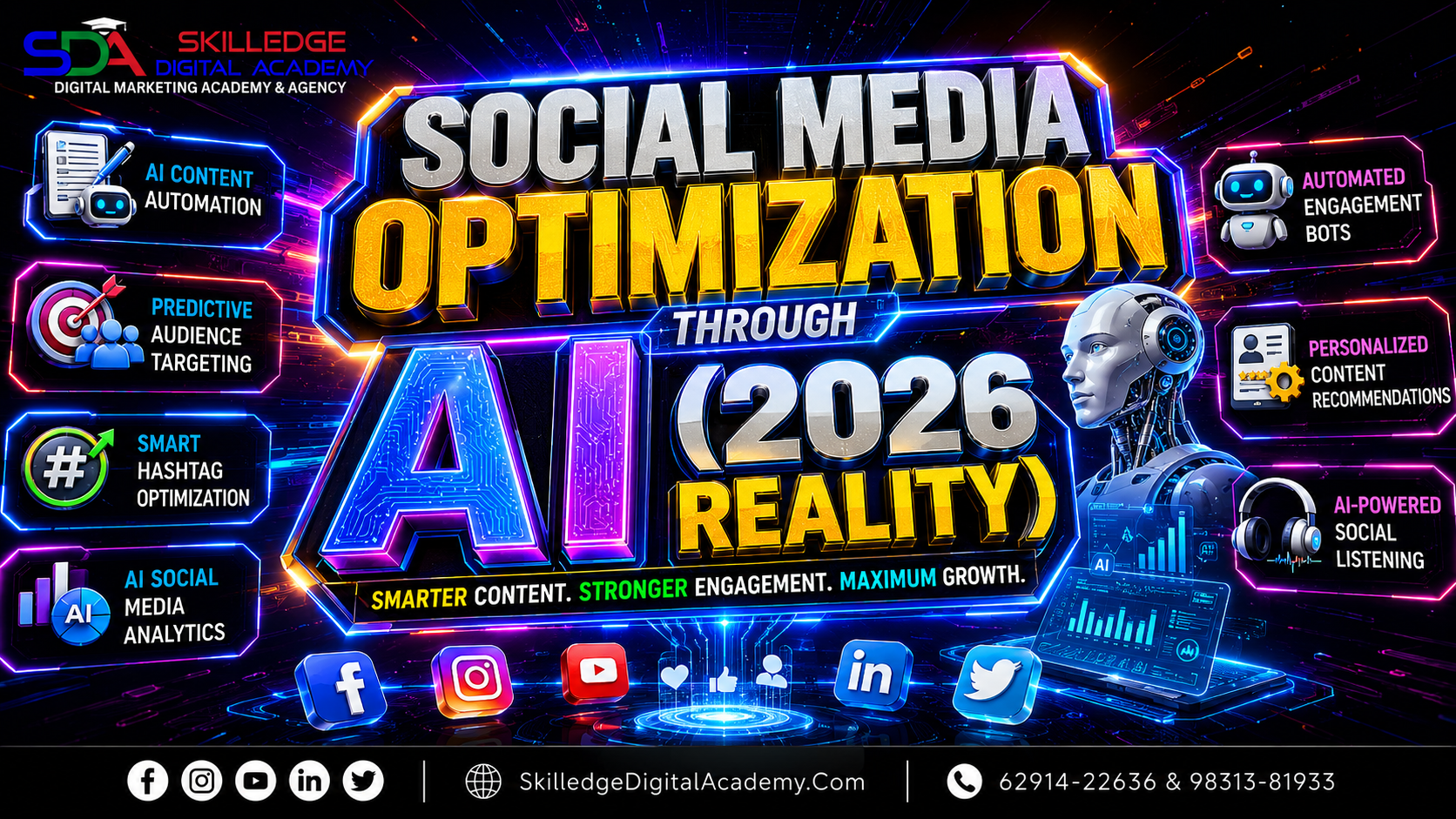
Advanced Strategy 5: Social Media Optimization Through AI (2026 Reality)
AI is reshaping Social Media Optimization, but human creativity still wins.
AI Tools That Help SMO:
Content Ideas: AnswerThePublic, Google Trends, Exploding Topics
Writing Assistance: Jasper, Copy.ai, Grammarly
Design: Canva AI, Midjourney, DALL-E 3
Scheduling: Buffer AI, Hootsuite Insights, Later
Analytics: Sprout Social, Agorapulse, Rival IQ
AI SMO Best Practices:
Use AI for research and drafting, not final publishing
Always add human perspective and personal stories
Don’t AI-generate entire posts (algorithms detect this)
Use AI to analyze data, not make creative decisions
Student Perspective: At Skilledge Digital Academy, we teach AI as a tool, not a replacement. Students who master AI-enhanced Social Media Optimization are 2.1x more productive and land higher-paying jobs.
Social Media Optimization Best Practices Checklist for 2026
Daily Social Media Optimization Tasks
Respond to all comments within 2 hours
Engage with 10–15 posts in your niche (thoughtful comments)
Share 1–2 Stories (behind-the-scenes, polls, Q&A)
Track key metrics (engagement rate, reach, follower growth)
Weekly Social Media Optimization Tasks
Create 5–7 posts for the week (batch content)
Analyze last week’s performance (what worked, what didn’t)
Plan next week’s content calendar
Reach out to 3–5 potential collaborators
Monthly Social Media Optimization Tasks
Audit all profiles (update bio, links, images if needed)
Review analytics dashboard (monthly trends)
Test 1–2 new content formats
Update keyword strategy based on search trends
Quarterly Social Media Optimization Tasks
Deep dive into ROI (revenue attributed to social)
Refresh top-performing content (update old posts)
Plan big campaigns (product launches, webinars)
Invest in new tools or training (like Skilledge Digital Academy courses)
Pro Tip: At Skilledge Digital Academy, we provide students with a ready-to-use SMO Checklist template that covers all these tasks. Students who follow it consistently grow 3.7x faster than those who wing it.
Why Skilledge Digital Academy Is Your Best Bet to Master SMO: What Makes Our Training Different
Most courses teach generic Social Media Optimization theory. At Skilledge Digital Academy, we teach what works in 2026 with Indian businesses.
Our SMO Curriculum Includes:
90% practical sessions (you’ll build real campaigns, not just watch videos)
Platform-specific modules (Instagram, LinkedIn, Twitter, YouTube, Facebook)
Live projects with real clients (build portfolio before graduating)
1-on-1 mentorship from industry experts (not just pre-recorded content)
Placement assistance with 500+ hiring partners (Amazon, Flipkart, Zomato, Nykaa, and more)
Lifetime access to updated content (algorithms change, we update)
Concrete Results:
94% placement rate within 6 months
Average starting salary: ₹4.8 LPA (highest: ₹12 LPA)
2,000+ students trained
4.8/5 average student rating
Student Testimonial: “I learned Social Media Optimization from 3 other courses before joining Skilledge Digital Academy. None of them taught me what actually works in 2026. After 3 months here, I landed a job at Amazon with ₹6 LPA and grew my personal LinkedIn to 15K followers. The Social Media Optimization strategies I learned here are gold.” — Ritika Sharma, Digital Marketing Executive at Amazon
Skilledge Digital Academy

Key Features at a Glance
| Feature | Details | Available |
|---|---|---|
| Free Demo Class | Experience a live session before committing | ✓ Yes |
| Live Online Training | Real-time classes with mentor interaction | ✓ Yes |
| 5+ Certifications | Google, Meta, HubSpot, SEMrush & more | ✓ Yes |
| 100% Placement Assistance | Resume review, mock interviews, referrals | ✓ Yes |
| Round the Clock Support | Mentor available 24/7 via WhatsApp & chat | ✓ Yes |
| Interview Preparation | Dedicated sessions + real interview simulations | ✓ Yes |
Training Modules Covered
Our curriculum is built for the 2026 industry:
| Module | What You’ll Master |
| SEO (Search Engine Optimization) | On-page, off-page, technical SEO & keyword strategy |
| SEM (Search Engine Marketing) | Paid search strategy, bidding, Quality Score optimization |
| SMO (Social Media Optimization) | Profile growth, organic reach, platform algorithms |
| SMM (Social Media Marketing) | Campaign strategy, content calendars, community building |
| Facebook & Instagram Ads | Meta Ads Manager, audience targeting, creative testing |
| Google Ads | Search, Display, Shopping, Performance Max campaigns |
| Website Development | WordPress, landing page design, CRO fundamentals |
| Graphic Designing | Canva, Adobe tools, social media creative design |
| Affiliate Marketing | Platforms, commission models, traffic monetization |
| Content Marketing | Blog strategy, copywriting, email marketing, funnels |
| AI Softwares & Tools | ChatGPT, Jasper, Midjourney, automation for marketers |
Enroll in our 3 month live online Digital Marketing training today! Enjoy 90% practical sessions, round-the-clock support, and 100% placement assistance.
Skilledge Digital Academy
Phone/WhatsApp: +91 62914-22636 / 98313-81933
Email: edu@skilledgedigitalacademy.com
Website: www.skilledgedigitalacademy.com